Saumya, Founder | 4 mins
A baby’s hand goes from the floor to a snack, from a toy to the mouth and back again before a parent can count the contacts. Neem sounds reassuring on a hand wash label, but hygiene is not created by one botanical. The useful question is how neem contributes without turning every wash into an aggressive antibacterial routine.
Table of Contents
- Neem in baby hand wash — what does it do?
- What hygiene actually means for baby hands
- How Indimums Hand Wash approaches everyday hygiene
- How It Compares
- How neem supports a cleansing formula
- Why synthetic antibacterial is not the same as better
- A handwashing routine that protects both hygiene and skin
- FAQs
Neem in baby hand wash — what does it do?
Quick Answer: Neem leaf extract can provide supportive antimicrobial activity in a baby hand wash, helping the formula address everyday hygiene without synthetic antibacterials such as triclosan. It does not sterilise hands. The cleansing base, washing technique and skin comfort still determine whether the hand wash works well for repeated use.
What hygiene actually means for baby hands
Healthy hand hygiene lowers the amount of dirt, food residue and microbes transferred to the mouth, eyes and shared objects. It does not aim to remove every microorganism. Babies interact with the world through touch, and an attempt to keep hands permanently sterile usually creates more washing than their thinner skin comfortably tolerates.
The World Health Organization centres effective hand hygiene on washing with soap and water at important moments. For babies and toddlers, the equivalent principle is simple: clean when exposure makes it useful, use enough friction to reach fingers and palms, rinse fully and dry gently. More antibacterial language on the label does not replace those steps.
How Indimums Hand Wash approaches everyday hygiene
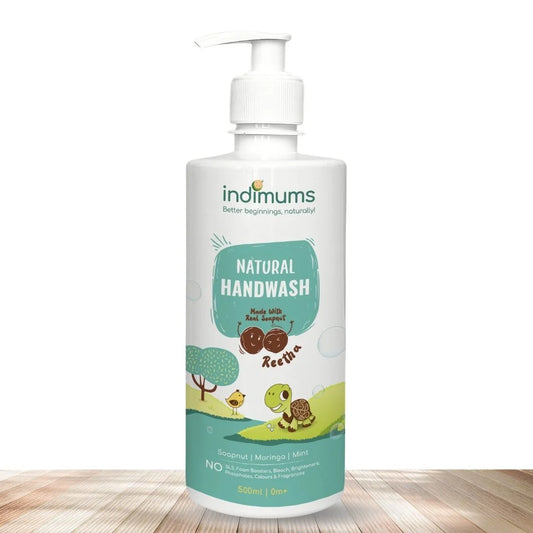
The Indimums Natural Hand Wash uses Reetha to loosen dirt through plant-derived saponins and Shikakai to help the post-wash feel remain soft. Moringa Leaf Extract supports skin through frequent washing, while Mint Essential Oil gives functional freshness without building the product around synthetic fragrance.
The formula avoids the idea that stronger scent or harsher foam equals safer hands. It is designed for the ordinary repeated moments of childhood: food, floors, outdoor play and toilet routines.
Make everyday hand hygiene effective enough for mess and gentle enough to repeat

How It Compares
| Aspect | Other hand washes | Indimums approach |
|---|---|---|
| Cleansing base | May use stronger sulphated surfactants | Reetha and Shikakai support effective gentle cleansing |
| Hygiene approach | May depend on synthetic antibacterial claims | Plant-based cleansing with supportive botanical extracts |
| Key ingredients | Perfume and foam can dominate | Reetha Shikakai Moringa and Mint |
| Hand feel | Can feel tight after repeated washing | Built for repeated kid handwashing |
| Fragrance | Strong synthetic scent may signal clean | No synthetic fragrance |
| Philosophy | Maximum-strength sensation | Clean at the moments that matter |
Synthetic antibacterial language can also encourage families to use hand wash for every touch rather than for meaningful exposure. That adds cumulative cleanser contact without improving technique. For babies who mouth their hands, rinse quality deserves particular attention: no visible foam should remain between fingers, around nails or in wrist creases. If dryness appears, first review frequency, dose and water temperature before adding more products to compensate.
How neem supports a cleansing formula
Neem leaves contain several bioactive compounds studied for antimicrobial and anti-inflammatory properties. In hand wash, neem leaf extract can support the formula’s hygiene role while the surfactant system does the main physical work of loosening oils, dirt and microbes so water can carry them away.
That distinction matters. Neem is not a magic shield left on the hands after rinsing, and responsible claims should not imply that it treats infection. Its value is complementary: it allows a formulation to pursue everyday cleanliness without building the product around a harsh “kill everything” experience.
Why synthetic antibacterial is not the same as better
Parents often associate a medicinal smell, strong cooling sensation or “99.9%” claim with superior protection. But repeated baby handwashing has two goals that must coexist: remove contamination and preserve the moisture balance of the skin. A formula that leaves hands tight may make the routine harder to repeat comfortably.
Synthetic antibacterial agents are not automatically needed for ordinary home handwashing. Triclosan, for example, is different from a cleansing surfactant and does not make rushed washing effective. For routine use, a well-designed cleanser and good technique are the foundation.
A handwashing routine that protects both hygiene and skin
Wet hands, use a small amount, work it across palms, backs of hands, between fingers and around fingertips, then rinse thoroughly. Dry by patting with a clean towel. For a baby who cannot wash independently, the adult controls both the amount and the temperature.
Wash before food, after toilet or diaper contact, after visible dirt and after high-contact public spaces. Moisturise if repeated washing leaves hands dry, and review the hand wash if tightness keeps returning. The best routine is targeted, complete and calm.
When repeated washing becomes the next question
This guide explains what neem contributes to a hand wash, but ingredient choice is only one part of hand comfort. Frequency changes the total exposure across a day, especially for babies whose hands are washed by several caregivers. The next blog helps you decide when washing is useful and when it is simply repetition.
Read next: How Often Should I Wash My Baby’s Hands?
Summary: Good hygiene does not need an aggressive after-feel
You started with fast-moving baby hands and the worry of what they collect. Neem can support the hygiene profile of a thoughtful wash, but effective cleansing still comes from the full formula and a complete rinse. Choose a routine that removes what matters without chasing sterility or leaving hands uncomfortable. If it does not serve your baby it does not go in.
FAQs
Q1. What does neem do in baby hand wash?
A1. Neem leaf extract provides supportive antimicrobial activity within the wider cleansing formula. It does not sterilise hands and should not be treated as a substitute for proper washing and rinsing.
Q2. Is neem hand wash safe for babies?
A2. Safety depends on the complete formulation, concentration and the child’s skin, not neem alone. Choose a baby-suitable wash, patch-test when appropriate and stop if irritation develops.
Q3. Does neem replace triclosan in hand wash?
A3. Neem can support hygiene without relying on triclosan, but the two are not identical ingredients or direct one-for-one substitutes. Effective handwashing still comes from cleansing action, enough contact, friction and thorough rinsing.
Q4. How often should I wash my baby’s hands?
A4. Wash after visible dirt, toilet or diaper contact, before eating and after high-contact outdoor play. Avoid washing by the clock when hands are clean, because unnecessary repetition can dry the skin.
Q5. Can neem hand wash prevent illness?
A5. Handwashing reduces the transfer of many germs, but no hand wash can guarantee that a baby will not become ill. Keep nails short, clean shared surfaces and follow age-appropriate hygiene alongside handwashing.
Q6. What should I avoid in baby hand wash?
A6. Avoid choosing by a strong perfume, intense cooling feel or “maximum germ kill” claim alone. Check for harsh surfactants, synthetic fragrance and formulas that leave hands tight after rinsing.