Every Indian parent knows the drill.
Before a feed. After a nappy change. After playing on the floor. After touching the dog. After coming in from outside. Baby hands go in the mouth constantly and washing them is one of the most repeated acts of care in a baby's day.
So the question of which hand wash to use is not a small one. It is a question you answer multiple times every single day.
And the answer from most paediatricians in India is not a brand name. It is an approach.
Which Baby Hand Wash Do Paediatricians in India Recommend?
👉 Quick Answer: Paediatricians in India broadly recommend a baby hand wash that is sulphate free fragrance free and free from synthetic antibacterial agents like triclosan. The formulation should be gentle enough for repeated daily use on infant skin and safe if trace residue reaches the baby's mouth. Plant based cleansers like reetha (soapnut) with natural antimicrobials like neem are considered among the most appropriate options for Indian babies given the climate and frequency of hand washing required.
Why Paediatricians Don't Recommend a Specific Brand?
If you've ever asked your paediatrician which hand wash to buy you've probably received a variation of the same answer. Something gentle. Something without too many chemicals. Something fragrance free.
That is not a non-answer. It is actually the most useful guidance they can give.
Paediatricians evaluate products on principles not on packaging. The principles for a safe baby hand wash are consistent across the medical community. The specific brand that meets those principles is something parents have to find for themselves by reading ingredient lists.
According to the American Academy of Pediatrics (AAP) the most important qualities in a hand cleanser for infants are mildness compatibility with infant skin pH and the absence of ingredients known to cause sensitisation. These are formulation principles not brand endorsements.
What paediatricians in India add to this is context. Indian babies wash their hands more frequently due to feeding routines outdoor play and family-style living. The best hand wash for kids in the Indian context needs to hold up to that frequency without drying or irritating skin that is already more exposed to environmental stressors.
The Indian Context: Why Frequency Matters More Here
Here's what most people miss about hand washing in India specifically.
In a typical Indian household a baby's hands are washed far more often than the global average. Multiple feeds a day. Extended family contact. Floor play. Outdoor spaces. Religious and cultural routines around cleanliness. All of this adds up to a hand washing frequency that is genuinely higher than what most global baby product formulations are designed around.
A natural hand wash that might be fine for three washes a day can become a problem at eight or ten washes a day if it contains sulphates or synthetic fragrance. The cumulative effect of repeated exposure to the wrong ingredients builds faster in the Indian daily routine than it would elsewhere.
This is why the ingredient standard for a baby hand wash in India is not just about what is in the bottle. It is about what that bottle does to small hands over the course of a full Indian day.
What Paediatricians Say to Avoid?
While paediatricians in India may not name specific brands they are consistent about what to avoid in any hand wash used on babies.
- Triclosan and triclocarban — synthetic antibacterial agents found in many hand washes marketed as germ killing. The WHO has flagged triclosan for contributing to antibiotic resistance. The AAP recommends against routine use of triclosan containing products in children. In India where many parents default to antibacterial hand washes for reassurance this is particularly worth knowing
- Sulphates (SLS/SLES) — create the heavy lather associated with thorough cleaning but strip the skin's natural oils with repeated use. For hands washed multiple times a day this leads to dryness cracking and increased sensitivity
- Synthetic fragrance — one of the most common causes of contact sensitisation in young children. In a product used this frequently fragrance compounds accumulate on skin that regularly contacts the mouth
- Alcohol based formulations — appropriate for sanitising in a healthcare setting. Not appropriate as a daily hand wash for infants. Drying irritating and not necessary for the bacteria typically encountered in a home
- Parabens — synthetic preservatives with potential hormone disrupting effects. Not appropriate for a product used this frequently on infant skin
- Harsh preservatives (phenoxyethanol MIT) — increasingly used as paraben alternatives but with their own concerns for repeated infant use
A hypoallergenic hand wash for babies will have none of these and the ingredient list will reflect that clearly.
What the Right Baby Hand Wash Looks Like?
A natural hand wash recommended for Indian babies needs to do three things well. Clean effectively. Protect the skin through repeated daily use. And leave nothing behind that causes a problem when those hands go in the mouth.
Look for:
- Reetha (soapnut) saponins — a plant derived cleanser with deep roots in Indian personal care. Reetha has been used for generations in Indian households for hand and hair cleaning because it cleanses effectively without stripping. Its natural saponins work at a pH compatible with infant skin and leave no synthetic residue. Learn why reetha is the right cleansing base
- Neem extract — one of India's most trusted natural antimicrobials. Neem targets common household bacteria without synthetic antibacterial agents and without contributing to antibiotic resistance. It is familiar safe and effective in the Indian context in a way that few ingredients from other traditions can match
- Aloe vera — soothes and hydrates hands that are washed frequently. Counteracts the drying effect of repeated cleansing
- Glycerin (plant derived) — a natural humectant that draws moisture into the skin. Essential for a hand wash used this frequently
- Essential oils in safe functional concentrations — for specific antimicrobial or soothing benefit. Not for fragrance
- Genuinely fragrance free formulation — or scented only with essential oils whose safety at infant skin contact is established
The best handwash for kids in India is not the one with the most foam or the strongest antibacterial claim. It is the one that keeps hands genuinely clean and genuinely healthy through the full Indian day.
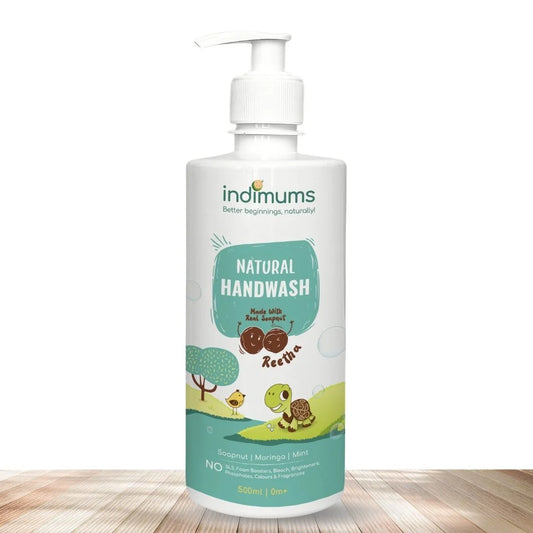
The Indimums Natural Baby Hand Wash
The Indimums Natural Baby Hand Wash was built around the specific demands of Indian baby hand care. Frequent washing. Hand to mouth contact. An Indian climate that already stresses infant skin. A parent community that reads ingredient labels and asks difficult questions.
The cleansing base is reetha (soapnut) — not an imported surfactant system adapted for the Indian market but a cleanser that has been trusted in Indian homes for generations. Combined with neem for natural antimicrobial action and aloe vera for post-wash hydration it is a formulation that makes sense for the Indian daily routine.
What's in it:
- Reetha (soapnut) — effective plant based cleansing at a pH compatible with infant skin
- Neem — natural antimicrobial support without triclosan or synthetic antibacterials
- Aloe vera — soothes and hydrates through repeated daily use
- Glycerin — maintains moisture balance for hands washed multiple times a day
- Essential oils in safe functional concentrations — no synthetic fragrance
What's not in it: Triclosan sulphates parabens synthetic fragrance alcohol phenoxyethanol or synthetic dyes.
Many parents across India who switch to this hand wash notice that the dryness and cracking that appeared toward the end of each day — normalised as just how baby hands are in winter or in AC environments — quietly stops. Not because the hand wash is moisturising in a cosmetic sense. Because it stops stripping the skin that was already dry from being washed so often.
How It Compares
| Aspect | Indimums Natural Baby Hand Wash | Typical Baby and Kids Hand Washes |
|---|---|---|
| Cleansing base | Reetha (soapnut) saponins | Synthetic sulphates (SLS/SLES) |
| Antimicrobial agent | Neem (plant based) | Triclosan or alcohol (synthetic) |
| Fragrance | Essential oils only (functional) | Artificial fragrance or parfum |
| Foam | Mild natural lather | Heavy synthetic foam |
| Skin impact after repeat use | Maintains moisture balance | Progressive drying and irritation |
| Mouth safe residue | Plant based minimal residue | Synthetic compounds not tested for ingestion |
| Suitable for Indian daily routine | Formulated for high frequency use | Formulated for standard adult frequency |
| Philosophy | Foundation first every wash is skin care | Hygiene first germ killing claim |
Thinking About What Else Goes on Baby Hands
The hand wash is one part of keeping your baby's hands and immediate environment safe. The surfaces those hands touch matter just as much.
👉 Read next: What Ingredients Should I Look for in a Gentle Hand Cleanser for Infants? — a deeper look at the specific ingredients that make a hand wash safe for the most sensitive infant skin and what each one does.
FAQs
Q1. Which baby hand wash is safest for newborns in India?
A1. For newborns in the first few weeks plain warm water is sufficient and recommended. When introducing a hand wash from around 3 to 4 months choose one that is completely sulphate free fragrance free and uses a plant based cleansing agent like reetha. The best hand wash for kids in India at this age is the one with the shortest ingredient list and the most recognisable ingredients.
Q2. Is antibacterial hand wash safe for babies in India?
A2. Most conventional antibacterial hand washes use triclosan or high alcohol concentrations. The WHO has flagged triclosan for antibiotic resistance concerns and the AAP recommends against routine use in children. For everyday hand washing in a home environment a natural hand wash with neem as the antimicrobial agent is both safer and sufficient. Triclosan based washes are not appropriate for repeated daily use on infant hands.
Q3. How often should I wash my baby's hands in India?
A3. Before every feed after every nappy change after outdoor play and after contact with pets or shared surfaces. In a typical Indian household this can mean eight to twelve hand washes a day. This is why choosing a genuinely gentle baby hand wash matters so much in the Indian context. A sulphate based wash used this frequently will cause dryness and cracking within days.
Q4. Can I use the same hand wash for my baby and my toddler?
A4. Yes provided it is formulated for infant skin. A natural hand wash like the Indimums formula is appropriate for newborns through toddlers and beyond. The reetha base and neem antimicrobial work equally well for all ages and the absence of sulphates and fragrance makes it safe for skin at every stage of development.
Q5. What are the signs that my baby's hand wash is too harsh?
A5. Dry or cracked skin on the hands especially by the end of the day. Redness around the knuckles or wrists where the wash pools. Fussiness or pulling away during hand washing. These are all signs that the current handwash for kids is stripping more than it should. Switch to a sulphate free fragrance free formula and allow two to three weeks to see the skin recover.
Q6. Should I stop my baby from putting hands in their mouth after washing?
A6. Hand to mouth contact is developmentally normal and important for sensory and immune development. You cannot and should not try to prevent it entirely. What you can control is what is on those hands after washing. A baby hand wash with plant based ingredients and no synthetic fragrance or antibacterial residue means hand to mouth contact after washing is not a concern. That is the real reason ingredient safety in a hand wash matters.
In Summary
Paediatricians in India do not recommend a specific hand wash brand. They recommend an approach. Gentle. Fragrance free. Plant based. Safe for the frequency of washing that Indian baby routines actually involve.
A natural hand wash built on reetha and neem with no triclosan no sulphates and no synthetic fragrance is not just the paediatrician approved approach. It is the approach that makes practical sense for the Indian baby's day.
Multiple washes. Small hands. Mouth contact after every one.
The right hand wash handles all of that quietly and consistently. That is what good foundation care looks like.