Saumya, Founder | 4 mins
A milk dribble dries at the neckline, banana settles into a sleeve and a diaper leak reaches the vest before the next wash. Baby stains are rarely one material. They combine proteins, oils, pigments and fine particles, which is why a gentle detergent still needs real cleaning chemistry. Reetha works because natural does not mean inactive.
Table of Contents
- Why is Reetha effective for removing baby stains?
- Why baby stains hold on to fabric
- How Reetha saponins loosen oils and residue
- How Indimums Laundry Detergent uses Reetha
- How It Compares
- Reetha and synthetic surfactants are not the same experience
- How to get better stain removal from a gentle detergent
- FAQs
Why is Reetha effective for removing baby stains?
Quick Answer: Reetha contains saponins, plant compounds with one part attracted to water and another attracted to oils. This structure helps water spread through fabric and loosen greasy soil, food residue and everyday grime so agitation and rinsing can remove them. Its effectiveness comes from surfactant behaviour, even though the cleansing material is plant-derived.
Why baby stains hold on to fabric
Milk and formula combine protein, fat and carbohydrate. Poop can add proteins, bile pigments and oils. Fruit brings colour compounds, while creams and massage oils create a water-resistant layer. Once a stained garment dries, these materials settle deeper into fibres and may oxidise, making the mark harder to lift.
This is why washing harder is not always the answer. Hot water can set protein stains, excess detergent can become difficult to rinse and scrubbing can damage soft fabric. The better strategy is to identify the stain family, act early and give the cleanser enough water and movement to work.
How Reetha saponins loosen oils and residue
Reetha, also called soapnut, is the fruit of Sapindus trees. Its shell contains saponins, compounds that lower surface tension so water can wet fabric more evenly. Their oil-attracting side associates with greasy residue while their water-attracting side remains in the wash water. Agitation helps lift the loosened soil; rinsing carries it out.
Laboratory research on Sapindus extracts shows emulsifying and soil-removal behaviour, although laundry performance depends on extraction, concentration and formulation. Reetha is therefore not just a heritage ingredient sprinkled into a detergent. It has a functional cleansing role that must be supported by dose, water and wash mechanics.
How Indimums Laundry Detergent uses Reetha
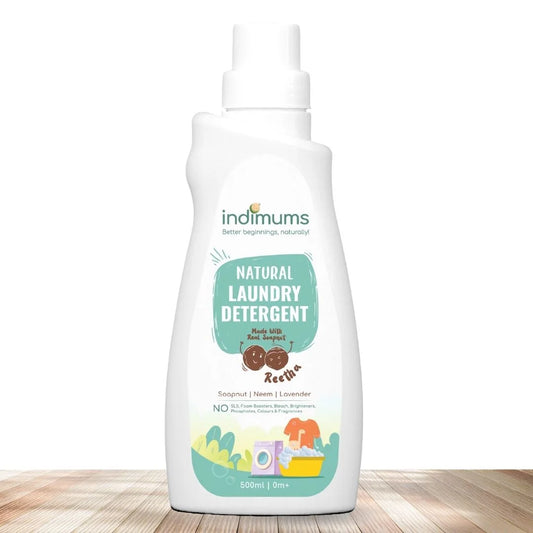
The Indimums Natural Laundry Detergent builds its cleansing base around Reetha, which helps lift stains and oils, and Shikakai, which works alongside it for fabric cleaning. Neem Seed Extract supports laundry hygiene, while Lavender Essential Oil is used in a functional concentration rather than as a synthetic perfume cloud.
The formula contains no SLS, synthetic fragrance, optical brighteners or parabens. The aim is visible cleaning without using scent or fluorescent whitening as proof that the fabric is ready for prolonged baby-skin contact.
Wash baby stains with a cleanser designed to remove residue rather than replace it with perfume

How It Compares
| Aspect | Other laundry detergents | Indimums approach |
|---|---|---|
| Cleansing base | May rely on synthetic surfactant blends | Reetha and Shikakai provide plant-derived cleansing |
| Stain approach | Foam or fragrance may signal performance | Saponins loosen oily and particulate soil |
| Key ingredients | May include optical brighteners and perfume | Reetha Shikakai Neem and Lavender essential oil |
| Fabric contact | Residue may be masked by scent | Designed around baby fabrics and rinsing |
| Fragrance | Synthetic perfume can linger | No synthetic fragrance |
| Philosophy | Make fabric look and smell intensely clean | Remove the stain without unnecessary add-ons |
Pre-treatment gives those saponins time to reach the stain before the full wash dilutes them. That is especially useful around collars, bib edges and cloth-diaper elastics where residue collects in layers.
Reetha and synthetic surfactants are not the same experience
“Surfactant” describes a job, not a moral category. Synthetic surfactants range from mild to strong, and plant-derived saponins also need careful formulation. The practical difference for baby laundry is whether the detergent removes stains at the recommended dose, rinses without a strong perfume layer and avoids extras such as optical brighteners that create the appearance of whiteness rather than removing soil.
A product can foam dramatically and still be overdosed. It can smell powerful and still leave milk film. For clothing worn against baby skin for hours, cleaning and rinsing matter more than perfume, brightness or a dramatic bucket of foam.
How to get better stain removal from a gentle detergent
Rinse fresh milk, formula, poop and egg stains from the back with cool water. Apply a small measured amount of detergent to the stained area, wait briefly without letting it dry and wash according to the fabric label. Avoid packing the machine so tightly that clothes cannot move.
For oily cream or massage-oil stains, blot first instead of spreading the oil. Repeat a gentle treatment before machine drying, because dryer heat can fix a remaining mark. Measure the detergent for load size and water conditions. More detergent is not more cleaning when the rinse cannot remove it.
Why the detergent decision continues after stain removal
This blog has explained how Reetha loosens complex baby stains. The next question is whether a detergent that cleans well also suits skin that reacts to fragrance, residue or repeated fabric contact. That distinction matters when clothes look clean but redness still appears under necklines, waistbands or folds.
Read next: Which Baby Laundry Detergent Is Safest for Sensitive Skin? — What Residue Does
Conclusion: The stain should leave without something new staying behind
You began with the ordinary stains that collect across one baby day. Reetha works because its saponins help water reach and loosen oily residue; careful pre-treatment and rinsing complete the job. A good wash does not need to trade a milk mark for heavy perfume or a brightener film. Build the result from stain timing, measured detergent and enough rinse water. Foundation over Fix.
FAQs
Q1. Why is Reetha effective for removing baby stains?
A1. Reetha contains saponins with water-friendly and oil-friendly parts that help loosen greasy and particulate residue from fabric. Washing action and rinsing then carry that loosened material away.
Q2. Can Reetha remove milk and food stains?
A2. It can help with milk fats, food oils and everyday grime, especially when stains are treated early. Dried protein stains may still need cold-water soaking and gentle pre-treatment before the main wash.
Q3. Is Reetha the same as a synthetic surfactant?
A3. Both can reduce the tension between water and oily soil, but they come from different sources and are formulated differently. A finished detergent must still be judged by cleaning performance, dose, preservation and rinse behaviour.
Q4. Does natural baby detergent leave residue?
A4. Any detergent can leave residue when too much is used, the machine is overloaded or rinsing is poor. Use the measured dose and add an extra rinse for heavy loads or very sensitive skin when needed.
Q5. Should baby stains be washed in hot water?
A5. Start protein stains such as milk, formula, egg and poop in cool water because heat can set them into fibres. Follow the fabric label and use warmer water later only when appropriate.
Q6. Can I use Indimums detergent for cloth diapers?
A6. Check the diaper manufacturer’s care instructions because absorbency and wash requirements vary. The detergent can clean baby fabrics, but correct dose, adequate agitation and complete rinsing remain essential for cloth diaper hygiene.