Can I Use Regular Body Wash on My Baby?

It seems like such a small thing. You're at the sink, your baby needs a wash, and your own body wash is right there.

Maybe it says "gentle" on the label. Maybe it's the same one you've used for years without a problem.

But here's the truth — what's safe for your skin is not automatically safe for your baby's. And the difference matters more than most parents realise until they see it on their baby's skin.

Can You Use Regular Body Wash on a Baby?

👉 Quick Answer: No — regular adult body wash should not be used on babies. Adult formulations are designed for mature, thicker skin with a different pH and a developed barrier. Baby skin is structurally thinner, more permeable, and far more sensitive. Using a regular baby body wash formulated specifically for infant skin is always the safer choice.

This isn't an overcautious position. It's backed by paediatric dermatology research — and it matters most in the first few years of life, when the skin barrier is still developing.

Why Baby Skin Is Fundamentally Different

A baby's skin isn't just smaller adult skin. It's structurally and functionally different — and those differences make it uniquely vulnerable to everyday products.

Key differences:

  • Thinner epidermis — the outermost layer of a baby's skin is significantly thinner than an adult's, offering less protection against external irritants
  • Higher permeability — ingredients in soaps, washes, and lotions absorb more deeply and quickly through infant skin
  • Higher surface-area-to-body-weight ratio — babies absorb more of whatever is applied relative to their body size
  • Still-developing skin barrier — the lipid matrix that keeps moisture in and irritants out is not fully formed until around two years of age
  • Different skin pH — newborn skin has a naturally higher pH that gradually acidifies over the first weeks; adult products formulated for a lower pH can disrupt this process

According to the American Academy of Dermatology (AAD), these differences mean that products applied to baby skin carry a higher risk of irritation, sensitisation, and systemic absorption than the same products used on adults.

If post-bath redness, dryness, or fussiness feels familiar — the product, not the bath, may be the reason.

What's in Regular Body Wash That Makes It Unsuitable

Most adult body washes — even those marketed as "gentle" or "moisturising" — contain a combination of ingredients that are simply not appropriate for infant skin.

Common problem ingredients:

  • Sulphates (SLS/SLES) — aggressive synthetic surfactants that strip the skin's natural oils; formulated for the oil production levels of adult skin, not a baby's
  • Artificial fragrance — one of the most common causes of contact dermatitis; adult fragrances are complex chemical blends that absorb readily through infant skin
  • Preservatives (parabens, formaldehyde-releasing agents) — present in most adult formulations at concentrations not studied for repeated infant exposure
  • Exfoliants (AHAs, BHAs, enzymes) — found in many "smoothing" adult washes; entirely inappropriate for infant skin that should never be exfoliated
  • High-foam boosters — create the lather adults associate with clean; strip infant skin of its fragile protective layer
  • pH-modifying agents — adult skin products are often formulated at a pH that suits adult skin, not the transitioning pH of newborn skin

A baby body wash without chemicals like these isn't a premium option — it's the baseline that infant skin requires.

What to Look for in a Baby Wash Instead

The best baby wash for your baby is one that cleanses effectively without disrupting the skin barrier your baby is still building.

Look for:

  • Plant-derived cleansing agents — like reetha (soapnut) saponins or mild glucosides; clean gently without stripping
  • Skin pH-compatible formulation — formulated to work with infant skin's natural pH range, not against it
  • Soothing botanicals — like aloe vera, neem, or calendula; support the skin during and after cleansing
  • No synthetic fragrance — essential oils in functional, safe concentrations are acceptable; artificial parfum is not
  • Short, readable ingredient list — every ingredient should have a clear purpose; anything unrecognisable is worth questioning
  • Dermatologically tested for infant skin — not just "paediatrician approved" as a marketing claim, but genuinely formulated and tested for babies

The best body wash for newborn use will produce less lather than an adult wash. That's not a flaw — it's a sign the formulation isn't relying on harsh foam boosters to feel effective.

What Happens When the Wrong Product Is Used Repeatedly

This is the part most parents discover gradually — not in one bath, but over weeks.

Repeated use of unsuitable products on baby skin can lead to:

  • Chronic dryness — the skin barrier gets stripped faster than it can recover, leaving skin persistently tight and flaky
  • Contact dermatitis — red, itchy, inflamed patches that often appear in skin folds, around the neck, or on the torso
  • Increased sensitisation — early exposure to irritating ingredients can increase the likelihood of allergic responses later in life
  • Disrupted skin microbiome — the skin's natural bacterial balance, which plays a role in immune development, can be altered by repeated chemical exposure

Research published in Pediatric Dermatology has highlighted that the early years represent a critical window for skin barrier development — and that repeated use of inappropriate cleansing products during this period can have lasting effects on skin sensitivity and resilience.

This is why the choice of natural baby body wash isn't about being overly cautious. It's about not undoing what the baby's skin is trying to build.

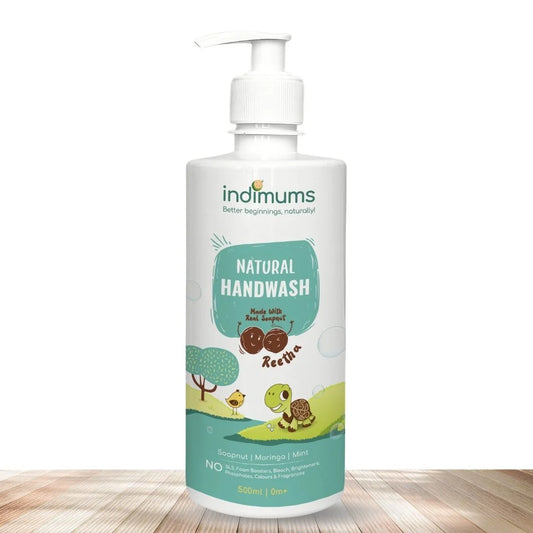
The Indimums Natural Baby Wash: Built for Baby Skin

The Indimums Natural Baby Wash was formulated with one clear principle: cleanse without stripping.

The cleansing base is reetha (soapnut) — a plant-derived cleanser used across generations in Indian households. Its natural saponins produce a gentle lather that removes dirt and oil without disrupting the skin's pH or natural lipid layer. It's inherently gentle, 100% biodegradable, and free from the stripping effect of synthetic sulphates.

What's in it:

  • Reetha (soapnut) as the primary cleansing agent — gentle, plant-based, pH-compatible
  • Aloe vera — soothes and hydrates during the wash
  • Neem — gentle antimicrobial support for the skin
  • Essential oils in safe, functional concentrations — no synthetic fragrance

What's not in it: SLS, SLES, parabens, artificial fragrance, mineral oil, synthetic dyes, or formaldehyde-releasing preservatives.

This is what a baby body wash for sensitive skin looks like when it's built for the skin — not for the shelf.

Many parents who've switched report that the post-bath redness, dryness, and fussiness they'd been normalising quietly disappears — not because the product is medicated, but because it stops doing the thing that was causing the problem.

How It Compares to Regular Body Wash

Aspect Indimums Natural Baby Wash Regular Adult Body Wash
Cleansing base Reetha (soapnut) saponins Synthetic sulphates (SLS/SLES)
Fragrance Essential oils only (functional) Artificial fragrance blends
Foam Mild, natural lather Heavy synthetic foam
Skin pH Formulated for infant skin pH Formulated for adult skin pH
Skin impact Non-stripping; supports barrier Strips natural oils; disrupts barrier
Sensitive skin Formulated for newborn-sensitive skin Not tested for infant use
Philosophy Foundation-first; ingredient transparency

Cosmetic performance; fragrance appeal

You're Already Thinking About Bath Frequency — Here's the Next Step

If you're being thoughtful about what goes on your baby's skin, bath frequency matters too — not just the product.

👉 Read: How Often Should I Bathe My Newborn With Body Wash? — covering how often newborns actually need a full bath, when body wash is necessary, and how to build a routine that supports rather than stresses infant skin.

In Summary

Regular body wash on a baby is one of those things that feels harmless — until you understand why it isn't.

Baby skin is not adult skin in miniature. It's a different structure, a different pH, a different permeability. And it's in the middle of building something — a barrier that will protect your child for life.

What you wash it with, repeatedly, during those first years, matters.

A natural baby body wash built on plant-based cleansers, without synthetic fragrance or harsh surfactants, isn't a luxury. It's just the right tool for the job.

That's the kind of quiet, consistent care that builds a foundation.

FAQs: Using Body Wash on Babies

Q1. Can I use my regular body wash on my baby in an emergency?
A1. Once or twice in an emergency is unlikely to cause lasting harm, but it should not become a habit. Regular adult body wash is formulated for adult skin pH and contains ingredients — including sulphates and fragrance — that are not appropriate for repeated use on infant skin. Switch to a proper baby body wash as soon as possible.

Q2. What makes baby body wash different from regular body wash?
A2. A genuine natural baby body wash is formulated for the specific pH, permeability, and sensitivity of infant skin. It uses milder, plant-derived cleansers; avoids synthetic fragrance and parabens; and is tested for infant skin compatibility. Adult body wash is designed for mature skin with a different pH, higher oil production, and a developed skin barrier.

Q3. Is baby body wash really necessary, or is plain water enough?
A3. For newborns in the first few weeks, plain warm water is sufficient and actually recommended. As babies become more mobile and start solid foods, a gentle baby wash becomes useful for effectively removing food residue and sweat from skin folds. The key is choosing one that's genuinely formulated for infant skin.

Q4. What is the safest body wash for a newborn with sensitive skin?
A4. The safest baby body wash for sensitive skin avoids sulphates, artificial fragrance, parabens, and synthetic dyes. Look for a plant-based cleansing base — like reetha or a mild glucoside — combined with soothing botanicals like aloe vera or neem. A short, readable ingredient list is always a good sign.

Q5. Can regular body wash cause eczema in babies?
A5. Repeated use of inappropriate cleansing products can disrupt the skin barrier and increase the likelihood of eczema flares in predisposed babies. According to the National Eczema Association, avoiding harsh cleansers and synthetic fragrance is one of the first recommendations for eczema-prone infant skin. A baby body wash without chemicals like sulphates and fragrance is strongly advised.

Q6. How do I know if a baby wash is genuinely safe?
A6. Read the full ingredient list — not just the front label claims. A genuinely safe best baby wash will have a short, plant-based ingredient list with no sulphates, no artificial fragrance, no parabens, and no synthetic dyes. "Paediatrician approved" and "gentle" on the front label are marketing terms, not formulation standards.

ब्लॉगवर परत