Saumya, Founder | 4 mins
Baby hands do not stay clean for long. They touch the floor, a teether, your clothes and then the mouth in one small loop. Reaching for hand soap feels obvious. The harder question is whether the soap was made for how often babies need washing.
Table of Contents
- Can You Wash Baby Hands With Hand Soap?
- Why Frequent Washing Changes the Skin Calculation
- Which Hand Soap Is Safe for a Toddler Who Washes Many Times a Day?
- At What Age Can Kids Start Using Adult Hand Soap?
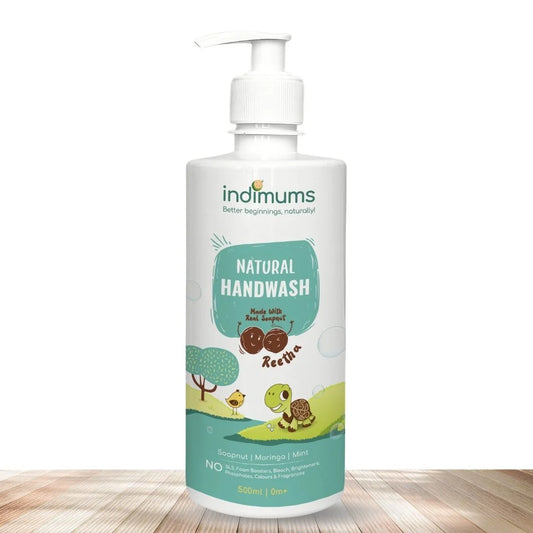
- The Indimums Baby Hand Wash
- How It Compares
- What Can I Use to Clean Baby Hands?
- FAQs
Can You Wash Baby Hands With Hand Soap?
Quick Answer: You can wash baby hands when they are dirty, but regular adult hand soap is not ideal for repeated baby use. Choose a baby hand wash that cleans without SLS, SLES, triclosan, alcohol-heavy feel or synthetic fragrance.
Why Frequent Washing Changes the Skin Calculation
Repeated exposure. Baby hand skin has less reserve against dryness. When hands are washed many times, each wash removes some natural surface oils.
Mouth contact. Hands go back to the mouth quickly, so fragrance and residue matter differently than they do for adult hands.
Which Hand Soap Is Safe for a Toddler Who Washes Many Times a Day?
A soap that feels comfortable after one wash may feel drying after the sixth. Frequency changes the effect of the routine even when the formula stays the same.
Repeated cleansing removes some surface oil each time. Toddler hands may move from meals to floor play, the toilet, outdoor surfaces and back to food in one day. With only a few hours between washes, the barrier has less time to recover than it would after occasional adult use.
Dryness can compound across the day. The first wash may feel normal, while later washes leave tightness around the knuckles or roughness between the fingers. This is a cumulative drying effect rather than surfactant physically building up on clean skin.
Fragrance is unnecessary for hygiene. Synthetic fragrance does not improve dirt removal and may irritate sensitive skin. The practical mouth-contact protection is thorough rinsing, not assuming every scented formula leaves a dangerous dose behind.
For repeated toddler washing, look for a mild surfactant base such as Reetha, Decyl Glucoside or Coco Glucoside; no SLS, SLES or triclosan; no strong synthetic fragrance; and a formula that rinses quickly. Dry gently, and moisturise cracked or eczema-prone hands when needed.
At What Age Can Kids Start Using Adult Hand Soap?
There is no fixed age at which every child should switch. A mild fragrance-free adult hand soap may suit one child, while a heavily fragranced or strong formula may dry another child's hands even years later.
Consider three factors: how often the child washes, whether they have eczema or sensitive skin, and how the hands look after several days of use. A child washing twice daily places a different demand on the barrier than a school-age child washing before meals, after the toilet, after play and after travel.
Indian dust, shared classroom surfaces and outdoor play may create more appropriate wash moments. That makes mild formulation and good technique more important: wet hands, use a small amount, rub all surfaces for about 20 seconds, rinse thoroughly and dry rather than leaving cleanser around rings, nails or finger webs.
The practical test is simple. If the hands remain comfortable, the formula is probably suitable. If the knuckles redden, the skin feels tight or cracks appear, move to a milder formula regardless of the child's age.
The Indimums Baby Hand Wash
The Indimums Natural Hand Wash for Kids is built for the wash frequency of childhood: enough cleansing for food, floor play and shared surfaces without using strong perfume or antibacterial theatre as proof of hygiene.
Reetha removes everyday dirt through plant-derived saponins, while Shikakai helps hands feel comfortable after rinsing. Moringa Leaf Extract supports skin health through repeated washing, and Mint Essential Oil provides a functional clean feel without synthetic fragrance.
What is not in it: SLS, SLES, triclosan, synthetic fragrance or alcohol-heavy cleansing.
“Repeated hand washing felt less drying for our toddler.” — Indimums Parent Community

Make every necessary hand wash gentle enough for the next one.
How It Compares
| Aspect | Indimums Kids Hand Wash | Typical Adult Hand Wash |
|---|---|---|
| Cleansing base | Reetha and Shikakai plant-based cleansing | May rely on SLS SLES or a stronger soap base |
| Fragrance | Mint Essential Oil in a functional concentration with no synthetic fragrance | Synthetic perfume may be used to signal cleanliness |
| Key ingredients | Reetha Shikakai and Moringa Leaf Extract | May focus on antibacterial or fragrance claims |
| Repeated-use impact | Designed for frequent childhood wash moments | Designed around adult skin and sensory expectations |
| Suitable for sensitive hands | No SLS SLES triclosan or synthetic fragrance | Suitability depends on surfactants fragrance and alcohol content |
| Preservation | Potassium Sorbate keeps the water-based formula stable | Preservative systems vary by formula |
| Philosophy | Clean what needs removing without making dryness the cost | Strong foam scent or antibacterial claims may lead the experience |
What can I use to clean baby hands?
- Reetha: lifts ordinary dirt without relying on SLS or SLES
- Shikakai: supports a comfortable after-rinse feel
- Moringa Leaf Extract: supports skin health through repeated washing
- Thorough rinsing: removes loosened dirt and cleanser before hands return to food or the mouth
For Reetha-based cleansing, you can read more about soapnut here.
If this concern feels familiar, the calmer answer is usually a better foundation, not a louder product.
Conclusion: Clean Hands Should Still Feel Like Baby Hands
You began with hands that move from floor to mouth before anyone can stop them. The answer is not to avoid washing. It is to make frequent washing gentle enough that the skin stays comfortable. Hygiene should support the routine, not punish the hands doing all the exploring. If it does not serve your baby it does not go in.
FAQs
Q1. Should kids use a different hand soap than adults?
A1. Not necessarily, but children who wash frequently or develop dryness benefit from a milder fragrance-free formula. The child's skin response, the surfactant system and washing frequency matter more than an adult or kids label. If knuckles become rough, red or tight, change to a gentler cleanser and review the washing routine.
Q2. Which hand soap is safe for babies?
A2. Choose a mild rinse-clean formula without SLS, SLES, triclosan or strong synthetic fragrance. Baby hands return to food, toys and the mouth quickly, so rinse thoroughly under running water and dry gently. A product made for repeated use should clean visible dirt without leaving the skin tight.
Q3. Is regular hand soap safe for young children to use every day?
A3. Many children can use a mild regular soap safely, but strongly fragranced or harsh formulas may become drying with repeated washing. Watch the hands rather than relying on the front label: persistent tightness, cracking or redness means the formula or frequency needs adjustment. A gentle kids hand wash can make repeated daily use more comfortable.
Q4. Do babies in India need hand washing after floor play?
A4. Wash after floor play when hands have visible dirt, before eating and after contact with bodily fluids or dirty surfaces. Indian dust and shared floors may create more wash moments, but every touch does not need soap. Use water alone for a light rinse when there is no meaningful soil to remove.
Q5. Is sanitiser better than hand wash for babies?
A5. Soap and running water are preferred when available, especially when hands are visibly dirty. Alcohol-based sanitiser can be useful when soap and water are unavailable, but an adult should apply and supervise it until fully dry to prevent swallowing or contact with the eyes. Keep sanitiser out of reach.
Q6. At what age can kids start using adult hand soap?
A6. There is no universal transition age. A mild fragrance-free adult soap may suit some children, while eczema-prone or frequently washed hands may need a gentler formula well into later childhood. If the hands feel tight, look red or crack around the knuckles, the current soap is too drying for that child's skin and frequency regardless of age.