Saumya, Founder | 4 mins
When we began formulating Indimums shampoo, the first question was not which ingredient would sound the most impressive on the front label. It was much simpler: what should clean a baby's scalp without making the scalp pay for being cleaned?
I had already read enough shampoo labels by then to see a pattern. Baby shampoos were often designed to feel reassuring to the parent: more foam, a soft fragrance, a slippery rinse and a long list that looked scientific enough to trust.
But as a mother, I kept coming back to one uncomfortable thought. If the scalp is still developing, why are we asking it to accept adult-style cleansing dressed in baby language?
Table of Contents
- Why we chose Reetha over every other cleanser when formulating Indimums Shampoo
- What we observed in other baby shampoos
- Why foam-first cleansing worried us
- Why Reetha made sense for baby scalp care
- How Reetha shaped the Indimums Baby Shampoo
- How It Compares
- What to avoid in baby shampoo labels
- What to choose instead
- FAQs
Why we chose Reetha over every other cleanser when formulating Indimums Shampoo
Quick Answer: We chose Reetha because it cleans with naturally occurring saponins instead of depending on harsh foam or strong synthetic cleansing feel. For baby scalp care, the goal is not maximum lather. It is removing sweat, oil and build-up while keeping the scalp comfortable enough for repeated washing through Indian weather, oiling routines and early childhood.
What we observed in other baby shampoos
Many baby shampoos are built around the way adults judge cleanliness. Foam feels clean. Fragrance feels fresh. A very smooth rinse feels premium. None of these things are automatically proof that the formula is supporting a baby's scalp.
When we looked closely at labels, we saw that some products still relied on surfactant systems made to create a satisfying wash experience. Some avoided the most obvious harsh names but still used a formula philosophy built around lather and sensory reassurance. Some used plant words on the front while the real cleansing work came from ingredients most parents would not recognise.
That gap between front-label comfort and back-label reality mattered to us. A baby shampoo is not a one-time product. It meets the scalp again and again after oiling, sweat, dust, monsoon humidity and bath days.
Why foam-first cleansing worried us
Foam is persuasive because parents can see it. It makes the wash feel active. But baby scalp does not need a dramatic foam story to be clean. In fact, chasing foam can push a formula toward stronger cleansing than fine baby hair and a developing scalp actually need.
Harsh surfactant systems can remove more oil than required. On adult hair, that may only feel like dryness. On baby scalp, it can show up as tightness, flaking, rough hair texture or the feeling that you need another product to fix what the cleanser disturbed.
This is the part that changed our thinking: the shampoo should not create the next problem. If a cleanser removes sweat and oil but leaves the scalp drier, the routine has not become better. It has only become more complicated.
Why Reetha made sense for baby scalp care
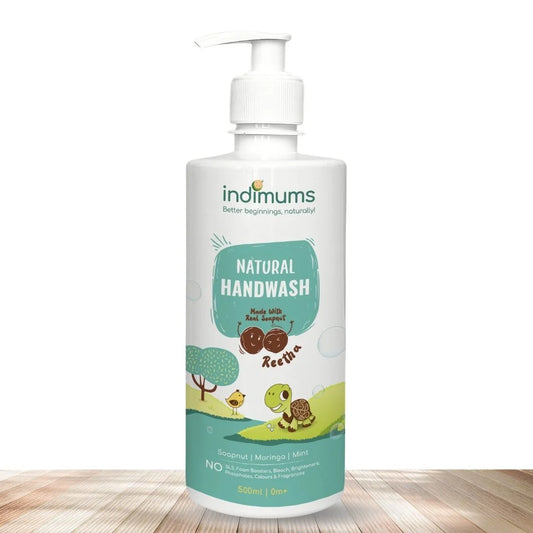
Reetha, or soapnut, contains natural saponins. Saponins help lift oil and residue, but they do it differently from the high-foam cleansing parents may associate with regular shampoo. The lather is softer, the feel is quieter, and the formula does not need to pretend that more bubbles mean more care.
Reetha also made sense because it belongs to Indian household memory. Many parents and grandparents know it as a traditional cleansing ingredient for hair. But we did not choose it only because it sounded traditional. We chose it because it matched the job: cleanse gently, rinse clearly and respect the scalp's natural balance.
For us, Reetha became the foundation. Not a decorative herbal mention. Not a front-label story. The cleansing base.
How Reetha shaped the Indimums Baby Shampoo
The Indimums Baby Shampoo begins with Reetha because we wanted cleansing that supports the scalp instead of overwhelming it. Shikakai helps keep hair soft without silicone coating. Neem leaf extract supports a calmer scalp environment when flakiness or discomfort appears. Almond oil and Flaxseed oil help the formula feel more supportive after washing, especially for fine baby hair.
We also made clear choices about what not to use. No SLS. No SLES. No synthetic fragrance. No parabens. No foam boosters. These omissions were not marketing decoration. They were part of the formulation brief from day one.
We were not trying to build a shampoo that behaved like an adult shampoo with a baby label. We were trying to build a baby shampoo whose first responsibility was the scalp.

How It Compares
| Aspect | Other shampoo | Indimums approach |
|---|---|---|
| Cleansing base | Often built around foam, slip or synthetic cleansing feel | Reetha works as the foundation cleansing ingredient |
| Lather | More foam may be used to signal stronger cleaning | Softer lather that does not chase adult-style shampoo performance |
| Key ingredients | Plant claims may sit beside a formula led by chemical bases | Reetha, Shikakai, Neem leaf extract, Almond oil and Flaxseed oil |
| Scalp impact | Can leave baby scalp dry, tight or dependent on follow-up products | Designed to clean build-up while supporting scalp comfort |
| Free-from choices | May include sulphates, synthetic fragrance or foam boosters | No SLS, no SLES, no synthetic fragrance, no parabens, no foam boosters |
| Philosophy | Make the wash feel impressive to the parent | Make the formula behave gently for the baby |
What to avoid in baby shampoo labels
Avoid judging a baby shampoo by lather alone. A shampoo can foam beautifully and still be more cleansing than the scalp needs. For babies, especially after oiling or during weather shifts, comfort after rinsing matters more than foam during washing.
Avoid vague herbal claims that do not tell you what is actually cleaning the scalp. If a product says natural but the cleansing base is unclear, the parent still does not know what the baby's scalp is meeting.
Avoid synthetic fragrance as a proof of freshness. A baby scalp does not need perfume to be clean. It needs a formula that removes what should come off and leaves the natural barrier alone.
What to choose instead
Choose a baby shampoo that makes its cleansing base easy to understand. The parent should not have to decode the label to know what is doing the main work.
Choose need-based washing over automatic shampooing. If the scalp has sweat, oil, outdoor dust or build-up, wash gently. If the day is light, plain lukewarm water may be enough.
Most of all, choose a formula that does not create a cycle of stripping and fixing. Good baby scalp care starts by disturbing less.
Why Reetha Was Not the Only Question
This blog explained why we chose Reetha as the cleansing foundation of Indimums Shampoo. But that decision did not happen in isolation. It came after reading baby shampoo labels closely and noticing how often foam, fragrance and front-label claims were doing more work than the actual formulation.
Read next: What We Found When We Read 20 Baby Shampoo Labels in India
Less foam can be the more thoughtful choice
We began with the same question a parent asks quietly during bath time: if a shampoo is made for babies, why does it need to behave like an adult shampoo? Reetha gave us a different starting point. It let us build around gentle cleansing, clearer labels and the belief that baby scalp care should not depend on foam, fragrance or instant sensory proof. Foundation-first care often looks quieter, but that is the point. What you leave out matters as much as what you put in.
FAQs
Q1. Why we chose Reetha over every other cleanser when formulating Indimums Shampoo?
A1. We chose Reetha because it cleans with natural saponins and supports a gentler cleansing philosophy. It helped us build a shampoo around baby scalp comfort instead of strong foam or adult-style wash feel.
Q2. Is Reetha safe for baby shampoo?
A2. Reetha can be suitable when used in a carefully formulated baby product and balanced with supportive ingredients. The full formula matters, not only the presence of one natural ingredient.
Q3. Does Reetha shampoo foam like regular shampoo?
A3. Reetha gives a softer cleansing feel and does not chase the heavy foam parents may expect from regular shampoo. Less foam does not mean less care when the formula is designed to clean gently.
Q4. Why did Indimums avoid SLS and SLES?
A4. SLS and SLES can create strong foam and cleansing, but baby scalp does not need that level of stripping. We avoided them because scalp comfort after washing mattered more than dramatic lather during washing.
Q5. What ingredients support Reetha in Indimums Shampoo?
A5. Shikakai supports softness, Neem leaf extract supports scalp comfort, and Almond oil and Flaxseed oil help maintain a more balanced after-wash feel. Together, they make the formula more than a single-ingredient story.
Q6. Is natural always better in baby shampoo?
A6. Not automatically. A natural ingredient still needs the right concentration, formulation and purpose. We chose Reetha because it matched the job we wanted the shampoo to do, not because natural wording alone was enough.