Saumya, Founder | 4 mins
There are two damp bibs by the sink, a milk-marked sleepsuit in the basket and yesterday's towels still drying indoors. Baby laundry rarely arrives as one tidy weekly load. In Indian homes, heat, monsoon humidity and different water supplies make the routine feel even less predictable. The useful answer is a repeatable system for washing, rinsing and drying, not simply a stronger detergent.
Table of Contents
- What Is A Practical Baby Laundry Routine For Indian Homes?
- How Often Should You Wash Baby Clothes, Towels And Bedding?
- How Indimums Laundry Detergent Fits A Measured Wash Routine
- How It Compares
- How Should You Set Temperature, Detergent Dose And Rinsing?
- FAQs
What Is A Practical Baby Laundry Routine For Indian Homes?
Quick Answer: Change and wash milk-soiled, wet or dirty items promptly, use the detergent dose for your load and water conditions, and choose a temperature allowed by the garment label. Run a complete rinse and dry every item fully before storing it. Separate heavily soiled items when needed; ordinary baby clothes do not automatically need a separate machine load or the hottest wash.
How Often Should You Wash Baby Clothes, Towels And Bedding?
Let the item's condition set the timing. A bib soaked with milk needs changing now, even if it has only been worn for an hour. Clothing with sweat, spit-up, food or nappy leakage should not sit against the skin while you wait for bath time. Clean-looking outer layers may last longer than underwear or the muslin repeatedly used during feeds. There is no hygiene benefit in making every item follow the same countdown.
Keep used laundry in a ventilated place away from clean clothing. Avoid leaving wet pieces bundled together for days, especially during monsoon. Handle visible stool carefully, remove solids appropriately and wash your hands afterwards. Cloth nappies need their own manufacturer's wash routine; treating them like a lightly worn vest can leave too much soil behind.
How Indimums Laundry Detergent Fits A Measured Wash Routine
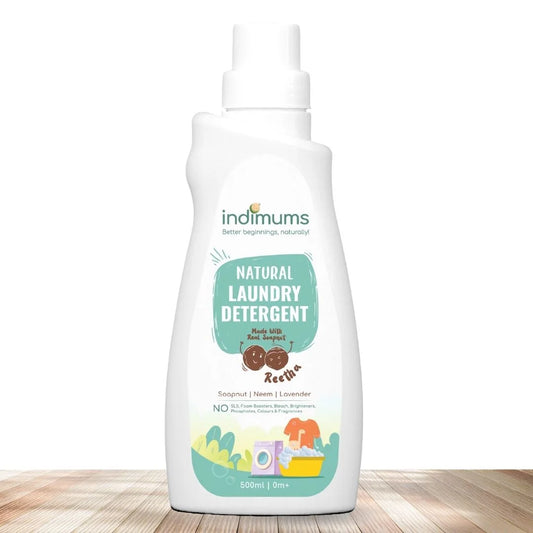
The Indimums Natural Laundry Detergent brings Reetha and Shikakai together in its cleaning base. Reetha's saponins help loosen oily soil so water can carry it away. Neem seed extract is part of the botanical blend, while lavender essential oil gives the formula a natural scent. The focus is the everyday laundry parents handle repeatedly: milk-marked cotton, washable bibs and the small clothes that fill a basket surprisingly quickly.
We leave out synthetic fragrance and optical brighteners, keeping the formula focused on washing rather than adding a strong perfume or a brighter-looking finish. That does not replace good dosing or a full rinse. Measure for the actual load and follow the product directions, including the machine settings. We want this to fit a routine you can repeat, with enough cleaning for the mess and enough care in the rinse and drying stages afterwards.
Make measured washing and thorough rinsing part of your baby's everyday laundry routine.

How It Compares
A detergent is one part of the result. This comparison separates the Indimums formulation from laundry choices that still need checking for any product.
| Aspect | Indimums Laundry Detergent | Other Laundry Options |
|---|---|---|
| Cleansing base | Reetha and Shikakai | Surfactant systems vary by product |
| Scent | Lavender essential oil; no synthetic fragrance | Fragrance-free and fragranced formulas are available |
| Optical brighteners | Not included | May be present; check the label |
| Botanical ingredient | Neem seed extract | Botanicals are optional, not a universal cleaning requirement |
| Dose | Follow the label for the actual load | Follow the label for the actual load |
| Rinse result | Depends on dose, water and programme | Also depends on dose, water and programme |
| Routine focus | Cleaning without synthetic perfume or brighteners | Choose for cleaning needs and skin tolerance |
How Should You Set Temperature, Detergent Dose And Rinsing?
Temperature: begin with the care label. Many everyday washable garments can use a 30 or 40 degree Celsius cycle when their label and detergent permit it. This is not a sterilising process. For washable cloth nappies, illness-related soiling or heavily contaminated items, use the recommended hygiene cycle and the highest temperature the fabric can tolerate. Do not boil delicate clothing because it belongs to a baby.
Milk or food marks are easier to deal with before they dry firmly into the fabric. Follow stain-care directions and check colourfastness before pretreating. Do not combine detergent with random household disinfectants or several stain products. A pale remaining stain and live contamination are not the same thing; aggressive repeated treatment can damage fabric without making a useful difference to everyday wear.
Dose: match the load, not the size of the bottle cap. Use the product's measuring directions for the machine type, load size and soil level. Hard water may require a different dose, but guessing an extra handful is not a reliable adjustment. Check the detergent guidance or ask the manufacturer. Under-dosing can leave dirt behind, while excess product increases what the rinse has to remove.
An extra rinse can help when there is visible suds retention or a suspected detergent issue, but it is not compulsory for every load. First correct overdosing or overloading. No foam does not prove that every ingredient is absent, and a strong scent does not measure residue. For eczema-prone skin, dermatology guidance favours fragrance-free detergent; lavender-scented products are not fragrance-free simply because the scent is botanical.
Does Liquid Or Powder Change The Rinse?
Once frequency and loading are settled, detergent format is the next practical question. Our liquid-versus-powder comparison looks at dissolving, dosing and rinsing without assuming one format always leaves less behind.
Read next: Liquid vs Powder Baby Laundry Detergent — Which Rinses Cleaner From Baby Clothes
Conclusion: Finish The Laundry Routine, Not Just The Wash
Those bibs, sleepsuits and slow-drying towels do not need one extreme setting for every load. They need a routine that follows the mess: timely changes, suitable washing, measured detergent, fresh rinsing and complete drying. The same principles work across a sunny balcony, a monsoon drying rack or a machine-dried load. Adjust the details to your home instead of chasing a stronger smell or another scoop. What you leave out matters as much as what you put in. Clean, dry fabric is the finish worth coming back to.
FAQs
Q1. Should I wash baby clothes separately from adult clothes?
A1. Ordinary baby clothes can share a load with compatible, similarly soiled family garments. Separate items needing a different temperature, heavily contaminated laundry or products your baby's skin does not tolerate.
Q2. What temperature should I wash baby clothes at in India?
A2. Follow the garment and detergent instructions; 30 or 40 degrees Celsius can suit many ordinary loads. Cloth nappies and illness-related soiling may need a hotter, specified process if the fabric allows it.
Q3. Does every baby laundry load need two rinses?
A3. No, a correctly dosed, properly loaded wash may rinse adequately on its normal programme. Consider an extra rinse when needed, but first check whether too much detergent or an overloaded drum caused the problem.
Q4. How much detergent should I use for baby clothes?
A4. Use the amount specified for your load size, water hardness and machine type. A small baby-clothes load should not automatically receive the same dose as a full family wash.
Q5. How should I dry baby clothes during monsoon?
A5. Remove them from the machine promptly and allow space and airflow around each item. Do not store them until seams, cuffs and thicker layers are fully dry.
Q6. Is naturally scented baby detergent fragrance-free?
A6. No, essential oils such as lavender contribute fragrance even when synthetic perfume is absent. A specifically fragrance-free care plan needs a genuinely fragrance-free product.