Saumya, Founder | 4 mins
Laundry can look like the least emotional part of baby care until a vest feels stiff, a towel smells too strongly or the skin under a onesie becomes suddenly fussy. Powder and liquid both promise a clean wash. The more useful question is what each one leaves in the fabric after the rinse cycle ends.
Table of Contents
- Liquid And Powder Do Not Rinse The Same Way In Every Home
- Why Rinse Quality Matters For Baby Clothes
- How Indimums Laundry Detergent Keeps The Formula Focused
- How It Compares
- How To Help Any Detergent Rinse Better
- FAQs
Does Liquid Or Powder Baby Laundry Detergent Rinse Cleaner From Clothes?
Quick Answer: Liquid and powder can both rinse clean when they are correctly dosed and matched to your water and machine. For baby clothes, the better option is the one with a clear, low-residue formula that dissolves fully and does not leave fragrance, brighteners or softener chemicals behind.
Liquid And Powder Do Not Rinse The Same Way In Every Home
The format is not the whole formula. Powder needs enough water movement and time to dissolve. In a short or cold wash, undissolved granules can settle into seams and towel loops. Liquid disperses quickly but can be easy to over-pour, especially when a cap makes a large dose look normal.
Indian water conditions add another variable. Hard water can make detergent work differently and can leave fabric feeling rough if the rinse is incomplete. A product that works well in one machine may need a smaller dose or an extra rinse in another. The cleanest-looking load is not always the best-rinsed load.
Why Rinse Quality Matters For Baby Clothes
A baby spends hours with fabric pressed against the neck, waistband, wrists and folds of the skin. Unlike a plate that is used once and set down, a vest holds against warm skin during feeds, naps and sleep. That makes fragrance residue, optical brighteners and excess surfactant more relevant than they are for an occasional adult load.
The practical sign to notice is not only visible soap. A perfume that stays strong after drying, a stiff towel, or clothing that feels slippery can indicate that the wash cycle needs attention. **Rinsing is part of cleaning, not the last optional step.**
How Indimums Laundry Detergent Keeps The Formula Focused
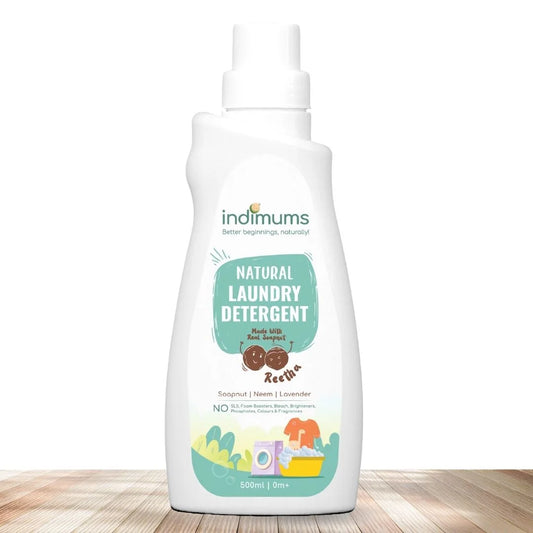
The Indimums Natural Laundry Detergent uses Reetha to lift stains and odours without an SLS-led surfactant base, with Shikakai to support thorough fabric cleaning. Neem seed extract is part of the hygiene-focused formula, while Potassium Sorbate helps keep it stable. Lavender essential oil is used lightly rather than as a synthetic fragrance signal.
It leaves out SLS, synthetic fragrance, optical brighteners, parabens and fabric-softener chemicals. The aim is not to make baby clothes smell louder after the wash. It is to leave fabric ready for long skin contact.
Choose laundry care that treats rinsing as part of what makes baby clothes clean.

How It Compares
| Aspect | Liquid Or Powder Detergents | Indimums Baby Laundry Detergent |
|---|---|---|
| Dissolving | Depends on dose, water temperature and wash duration | Liquid formula designed for measured use |
| Cleansing base | May rely on synthetic surfactants and softener chemicals | Reetha and Shikakai support fabric cleaning |
| Fragrance | Synthetic scent can remain after drying | Light Lavender essential oil, no synthetic fragrance |
| Fabric contact | Optical brighteners may stay close to skin | Free from optical brighteners and parabens |
| Philosophy | A strong scent can be treated as proof of washing | Clean fabric should not announce itself through residue |
How To Help Any Detergent Rinse Better
Sort very soiled clothes from light everyday loads. Do not overload the drum, because water needs room to move through fabric. Use the smallest effective dose, follow your machine’s rinse cycle and add an extra rinse when the water is hard, clothes feel stiff or scent stays obvious after drying.
For powder, dissolve it fully according to the product directions before it meets the clothes. For liquid, resist filling the cap automatically. The correct amount is the amount that leaves the load clean and clear, not the largest amount the bottle can hold.
Residue Shows Up In More Than One Form
This article has separated detergent format from the more important question of how well a formula rinses in your home. The next read looks closely at the ingredient categories that can stay behind in fabric long after the wash looks finished.
Read next: Baby Laundry Detergent Ingredients Parents Should Check
Conclusion: The Right Wash Leaves Less Behind
Liquid versus powder is worth thinking about, but neither label answers the whole baby-laundry question. Dose, water, wash length and the formula itself all decide what stays in a onesie after the cycle ends. When clothes sit against skin for hours, the quietest rinse is often the most useful result. Foundation over Fix. Choose a routine you can adjust without relying on scent to tell you it worked.
FAQs
Q1. Is liquid or powder detergent better for baby clothes?
A1. Neither format is automatically better. The more useful test is how fully the product dissolves and rinses from the specific water, wash cycle and amount used in your home.
Q2. Can powder detergent leave residue on baby clothes?
A2. Powder can leave residue when it is overused, not dissolved first or used in a short cold-water wash. This is a dosage and rinsing problem, not a rule that every powder is unsuitable.
Q3. Can liquid detergent leave residue on baby clothes?
A3. Liquid can also leave residue if too much is used or if the clothes are not rinsed well. Fragrance and fabric-softener additions can be more noticeable on a baby’s clothes after drying.
Q4. What detergent is safe for newborn clothes?
A4. Choose a detergent with a clear cleaning base and without synthetic fragrance, optical brighteners, parabens or fabric-softener chemicals. Use the smallest effective dose and complete the rinse cycle.
Q5. How much baby laundry detergent should I use?
A5. Use the lowest amount that cleans the load in your machine and water conditions. More detergent does not remove more stains once the load is saturated; it can simply make rinsing harder.
Q6. Why do baby clothes feel stiff after washing?
A6. Stiffness can come from excess detergent, hard water, incomplete rinsing or too much heat in drying. Run an extra rinse before changing the product entirely.