Saumya, Founder | 4 mins
At some point, the laundry piles start merging. Baby vests sit beside towels, your kurta and a bedsheet waiting for the same wash. That is when many parents wonder whether baby laundry detergent is still necessary or whether regular detergent can finally take over.
Table of Contents
- How Long Do I Have to Use Baby Laundry Detergent?
- Difference between baby laundry detergent and regular?
- Why Fabric Residue Matters for Babies
- The Indimums Baby Laundry Detergent
- How It Compares
-
What ingredients to avoid in baby laundry soap?
- FAQs
How Long Do I Have to Use Baby Laundry Detergent?
Quick Answer: Use baby laundry detergent at least through the first year, and longer if your baby has dry, eczema-prone or sensitive skin. The better marker is not age alone, but whether regular detergent leaves scent, stiffness or residue against the skin.
Difference between baby laundry detergent and regular?
Baby detergent matters because clothes, towels and sheets stay on the skin for hours. The National Eczema Association recommends fragrance-free laundry choices for sensitive skin. In parent language, what remains in fabric can matter as much as what touched the skin directly. Here is what most people miss: laundry is a leave-on exposure disguised as a wash-off routine.
Why Fabric Residue Matters for Babies
Long contact time. A body wash touches skin for minutes. Clothes touch the neck, waist, folds and back for hours.
Developing barrier. Baby skin loses moisture faster than adult skin. Fragrance and brightener residue can rub repeatedly where fabric sits close.
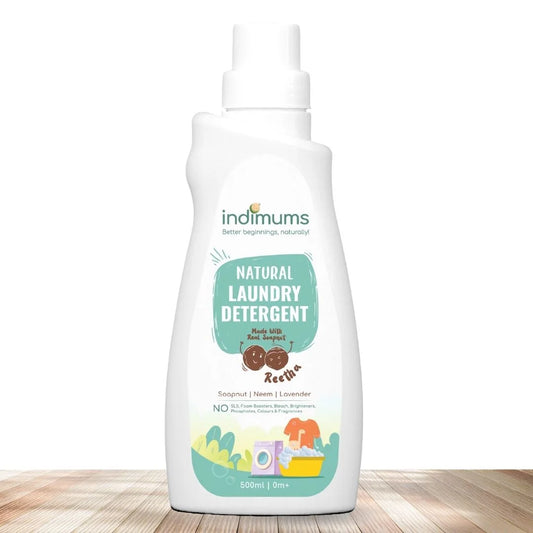
The Indimums Baby Laundry Detergent
The Indimums Baby Laundry Detergent is built for fabric that stays on skin for hours — not for a quick rinse and done.
What is in it:
- Reetha (soapnut) - plant-based cleansing that removes stains without synthetic surfactant residue
- Shikakai - works with Reetha for thorough cleaning and fabric softness
- Neem - supports clothing hygiene
- Lavender essential oil - functional only, not synthetic fragrance
- Potassium sorbate - food-grade preservative that keeps the formula stable
What is not in it: synthetic fragrance, optical brighteners, sulphates, parabens, phosphates, fabric softener chemicals, synthetic dyes.
If the switch is not ready yet, the routine should not be either — Indimums Natural Baby Laundry Detergent washes without residue, at every age.

How It Compares
| Aspect | Indimums Baby Laundry Detergent | Typical laundry detergent |
|---|---|---|
| Cleansing or moisturising base | Reetha (soapnut) - plant-based cleansing that removes stains without synthetic surfactant residue | Usually synthetic surfactant, soap base or heavy coating oil |
| Fragrance | No synthetic fragrance focus | Often built around perfume or strong scent |
| Key active ingredients | Reetha (soapnut), Shikakai, Neem, Lavender essential oil | Often listed broadly without explaining function |
| Skin, scalp or surface impact | Designed around residue-conscious baby contact | Often designed around adult sensory expectations |
| Suitable for sensitive or newborn skin | Avoids synthetic fragrance, optical brighteners, sulphates, parabens | May include avoidable fragrance, surfactants or coating agents |
| Preservatives | Uses food-grade potassium sorbate for stability | Typical formulas may use stronger preservative systems |
| Philosophy | Foundation-first care that removes what is not needed | More foam, scent or shine is often treated as proof |
What ingredients to avoid in baby laundry soap?
- Synthetic fragrance - can stay in fabric that touches baby skin for hours
- Optical brighteners - make clothes look brighter without making them safer
- Sulphates - can leave a stronger detergent feel in fabric
- Phosphates - are unnecessary for baby laundry routines
- Fabric softener chemicals - coat fibres instead of simply cleaning them
- Synthetic dyes - add appearance without skin benefit
None of this means parents need to panic. It only means the ingredient list should do fewer, clearer jobs.
What Are the Benefits of Using Baby Laundry Detergent?
Parents often ask this when the cost of a separate detergent starts adding up or when the laundry routine gets complicated with a second child. The honest answer is that the benefits are not about cleaning power — regular detergent cleans clothes effectively. The benefits are about what is not left behind.
Fragrance-free washing — clothes that touch baby skin for 12 to 14 hours a day carry whatever the detergent leaves in the fabric. A baby-specific detergent avoids synthetic fragrance that regular detergents use as a freshness signal.
No optical brighteners — these coat fabric to make it look whiter under UV light. They stay in fibre and are not necessary for baby clothes to be clean.
Lower residue — baby detergents are formulated to rinse more completely from fine cotton and muslin. The result is fabric that feels softer against skin without a coating layer.
Gentler on developing skin barrier — baby skin loses moisture faster than adult skin. Repeated contact with residue from stronger detergents can compound this.
At What Age Can You Wash Baby Clothes in Regular Detergent?
There is no universal age. The markers that matter are:
Skin response — if your baby's skin shows no redness, dryness or rash after contact with regularly-washed fabric, the switch may be fine. If skin reacts — especially in folds, around the waist or wherever elastic sits — the detergent residue may be the cause.
Fragrance tolerance — some children remain sensitive to synthetic fragrance in fabric well past toddler age. The switch is ready when the skin is ready, not when a calendar date arrives.
Product ingredients — switching to regular detergent is lower risk if the regular detergent is fragrance-free, brightener-free and low-residue. Switching to a heavily fragranced adult detergent is higher risk regardless of age.
In Indian conditions — sweat reactivates fragrance in fabric. A detergent that smells mild in winter can feel stronger on a child who sweats through summer. The Indian climate shifts when the switch is appropriate.
Ingredient Choices Decide Whether Clothes Feel Truly Clean
This blog answers how long a baby detergent may need to stay in your routine. The linked blog explains which laundry ingredients are worth avoiding and why. Read it next before switching baby clothes into the family wash.
Read next: What Ingredients Should I Avoid in Baby Laundry Detergent?
Baby clothes should come back clean, not coated
You started at the laundry pile, wondering when baby clothes can join the regular load. The calmer answer is to watch the skin and fabric, not only the calendar. Clean baby clothes should come back without perfume, stiffness or unnecessary coating. The routine is working when the fabric supports the barrier quietly. Made for parents who think.
FAQs
Q1. How long should you use baby laundry detergent?
A1. Through the first year at minimum — and longer if your baby has dry, sensitive or eczema-prone skin. The right signal is not age but skin response. If clothes washed in regular detergent leave redness, stiffness or a scent that stays on the fabric — the switch is not ready yet.
Q2. When can I stop using baby detergent?
A2. When the skin gives you permission — not the calendar. Try washing one batch of clothes in a fragrance-free regular detergent and observe the skin for 48 hours. If there is no reaction, the transition can begin gradually. If skin reacts around folds, waist or anywhere fabric sits close — continue with baby detergent.
Q3. When can I use scented detergent on baby clothes?
A3. Synthetic fragrance in laundry stays in fabric after washing and sits against skin for hours. For babies with sensitive or eczema-prone skin, scented detergent may not be appropriate at any age. For babies with no skin sensitivity, a mild naturally-scented option — lavender essential oil rather than synthetic fragrance — is a lower-risk transition than a heavily perfumed adult detergent. In Indian heat and humidity, fragrance reactivates in fabric with sweat — making it more noticeable and more irritating in summer and monsoon months.
Q4. Does Indian heat affect baby laundry?
A4. Yes. Sweat makes clothes touch skin differently, so residue and fragrance can feel stronger in hot weather.
Q5. Can I wash baby clothes with family clothes?
A5. You can if the detergent is baby-suitable and the load is not heavily soiled with adult products.
Q6. Do baby clothes need fabric softener?
A6. No. Fabric softener chemicals can coat fibres and are not necessary for baby skin comfort.