Saumya, Founder | 4 mins
The clean vest goes on in the morning, and by afternoon redness has appeared under the neckline, waistband or sleeves. Because the timing follows laundry day, detergent becomes the obvious suspect. Sometimes that link is real. Sometimes the wash changed the fabric, fragrance exposure or heat around the skin while the detergent itself is only one part of the pattern.
Table of Contents
- Baby skin rash after laundry day
- What makes a laundry-linked rash plausible
- How Indimums approaches baby laundry
- How It Compares
- Why detergent is not always the cause
- How detergent residue and fragrance reach baby skin
- A safe way to test the laundry routine
- When the rash needs medical attention
- FAQs
Baby skin rash after laundry day — is it the detergent?
Quick Answer: Detergent may contribute when a rash appears mainly beneath freshly washed clothes, improves after rewashing and returns with the same product. Fragrance, dyes, excess dose, fabric softener and incomplete rinsing are common suspects. But sweat, eczema, rough fabric, new clothing dye or infection can produce a similar rash, so timing alone does not prove the cause.
What makes a laundry-linked rash plausible
A detergent-related problem is more plausible when redness follows a new product, changed dose, missed rinse or fabric-softener use. Contact areas often carry the strongest clue: necklines, cuffs, waistbands, back, cloth-diaper elastics and folds where damp fabric presses against skin.
The reaction may be irritant contact dermatitis, caused by repeated exposure that disrupts the barrier, or allergic contact dermatitis, an immune response to a particular ingredient. Allergic detergent reactions appear to be uncommon overall, but fragrance and certain preservatives are recognised contact allergens. Babies with eczema can also flare from product triggers without having a true detergent allergy.
How Indimums approaches baby laundry
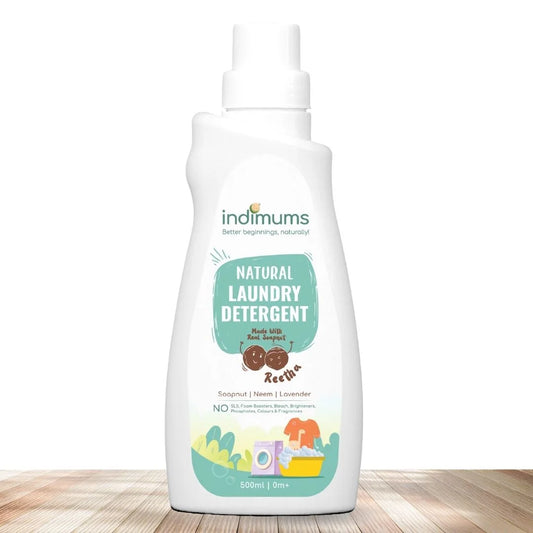
The Indimums Natural Laundry Detergent uses Reetha to loosen oils and stains through plant-derived saponins, Shikakai to support fabric cleaning, Neem Seed Extract for hygiene and Lavender Essential Oil in a functional concentration rather than a synthetic perfume system.
The formula contains no SLS, synthetic fragrance, optical brighteners or parabens. It is designed to clean baby fabrics without using an intense lingering scent or fluorescent whiteness as proof of performance. Correct dosing and rinsing still remain essential.

How It Compares
| Aspect | Other laundry detergents | Indimums approach |
|---|---|---|
| Cleansing base | May use synthetic surfactant blends | Reetha and Shikakai provide plant-derived cleansing |
| Fragrance | Synthetic perfume may remain as a freshness cue | No synthetic fragrance |
| Key ingredients | Optical brighteners softeners or dyes may be added | Reetha Shikakai Neem and Lavender essential oil |
| Skin contact | Strong scent can persist through wear | Designed for baby fabrics with measured use |
| Residue strategy | More foam and product may be encouraged | Cleaning depends on dose agitation and rinse |
| Philosophy | Make clothes smell intensely washed | Remove soil without replacing it with perfume |
Why detergent is not always the cause
Laundry day often changes several things together. Clothes may be sun-dried until stiff, worn before completely dry, washed with a new softener or put on during hot weather. Sweat trapped under a snug bodysuit can create heat rash. A rough seam can create friction. New garments can carry dye and finishing chemicals even before detergent enters the picture.
Look at areas not covered by clothing. If the face, scalp and diaper edge are also affected, consider a broader eczema flare, viral rash or another exposure. A useful investigation changes one variable at a time instead of replacing every baby product at once.
How detergent residue and fragrance reach baby skin
Clothes remain against baby skin for hours, so even a small amount of residue gets long contact time. Residue rises when too much detergent is used, the drum is packed tightly, water is hard or the rinse volume is low. Fabric softener intentionally leaves conditioning and fragrance compounds behind, which is why it deserves separate attention.
The American Academy of Dermatology recommends fragrance-free and dye-free laundry detergent for eczema-prone children, using the recommended amount and enough water for rinsing. “Fragrance-free” is different from “unscented”: an unscented product may use masking fragrance to hide its smell.
A safe way to test the laundry routine
Stop fabric softener and dryer sheets. Rewash a small set of clothes with the measured detergent dose, no other laundry additive and an extra rinse. Let them dry fully, then use only those garments for two or three days while keeping skincare and clothing fabric unchanged.
If the rash improves and returns when the old routine returns, you have a stronger clue. If it persists, inspect seams, heat, sweat, new-clothing dye and products applied directly to skin. Photograph the pattern in consistent light and record timing; that evidence is more useful to a doctor than a general memory of “after laundry.”
When the rash needs medical attention
Seek urgent care for breathing difficulty, facial swelling, blistering, widespread peeling, fever or a rapidly spreading rash. Ask a clinician about persistent itching, oozing, yellow crusts, sleep disruption or repeated flares. Do not apply strong steroid, antifungal or antibiotic creams without age-appropriate advice.
If contact allergy is suspected, a dermatologist may consider patch testing. Until then, simplify: soft cotton, fragrance-free direct-contact products, measured detergent and complete rinsing. The goal is to identify the trigger, not prove the detergent guilty.
When residue becomes the more useful laundry question
This guide helps you investigate a rash without jumping to one conclusion. The next blog focuses specifically on detergent choice for sensitive skin and explains why residue, fragrance and fabric contact matter after the wash cycle ends. Read it if the rash repeatedly follows the same clothes.
Read next: Which Baby Laundry Detergent Is Safest for Sensitive Skin? — What Residue Does
Conclusion: A laundry clue is useful but it is not a diagnosis
You began with redness appearing beneath clean clothes. Detergent may be part of that pattern, especially when fragrance, softener, excess dose or incomplete rinsing is involved, but skin, fabric and weather can produce the same timing. Rewash a controlled set, change one variable and watch the contact pattern instead of replacing the whole routine. When symptoms persist or intensify, let a clinician identify the rash. Questioning is also care.
FAQs
Q1. Can laundry detergent cause a baby skin rash?
A1. It can contribute through fragrance, dye, residue or an ingredient sensitivity, especially in babies with eczema. However, heat, sweat, rough fabric and an unrelated rash can appear on laundry day too.
Q2. What does a detergent rash look like on a baby?
A2. It may appear as itchy redness, dry patches or small bumps where clothing stays close to the skin. Appearance alone cannot confirm the cause, so track timing, clothing contact and other recent changes.
Q3. Should I rewash baby clothes after a rash?
A3. Rewash recently cleaned clothes without fabric softener using a measured fragrance-free detergent and an extra rinse. If the rash is severe, spreading or uncomfortable, seek medical advice instead of relying only on rewashing.
Q4. Is fragrance-free detergent better for sensitive baby skin?
A4. Fragrance-free removes a common source of contact sensitivity and is recommended for eczema-prone children. “Unscented” can still contain masking fragrance, so read the wording carefully.
Q5. Can too much detergent stay in baby clothes?
A5. Yes, especially when the machine is overloaded, water is hard or rinsing is limited. Using more than the recommended dose can leave fabric stiff, strongly scented or soapy when wet.
Q6. When should a baby rash be checked by a doctor?
A6. Seek prompt advice for fever, swelling, blistering, oozing, breathing difficulty, facial involvement or a rapidly spreading rash. Persistent or recurrent rashes may need examination and allergy or eczema assessment.