The 2-in-1 bottle sits in almost every baby aisle. One product, two jobs, half the clutter. The convenience argument is real. The formulation question is worth asking before the convenience wins.
👉 Quick Answer: A 2-in-1 baby shampoo and body wash can be safe if it is sulphate-free, fragrance-free and pH-balanced. The honest limitation is formulation compromise — scalp skin and body skin have different needs and a single formula has to split the difference. For everyday use on a healthy baby it is acceptable. For a baby with dry scalp, eczema or sensitive skin, separate products built for each surface make more sense.
Why One Formula Has to Compromise
The scalp and the body are not the same surface. They have different oil production, different pH levels and different cleaning needs.
The scalp produces sebum. This natural oil coats each hair strand and keeps the scalp balanced. A shampoo needs to remove sweat and buildup without stripping that oil layer. Strip too much and the scalp gets dry, flaky or overproductive in response.
Body skin needs moisture retention. A body wash needs to remove surface residue — sweat, milk, oil massage — without disturbing the lipid barrier that keeps skin soft and hydrated. Baby skin loses moisture faster than adult skin. A wash that is too active makes this worse.
When one formula tries to do both jobs it has to find a middle point between two different requirements. The cleansing base is neither optimised for scalp nor fully gentle enough for body skin. This is not a failure of the product — it is a structural limitation of the format.
Here is what most people miss: the compromise is invisible in healthy skin. It becomes visible when the scalp starts flaking, when body skin feels dry after every bath, or when buildup accumulates over weeks of use.
What to Avoid in 2-in-1 Products
If you are using or considering a 2-in-1, the ingredient list matters more than the format.
- SLS and SLES — synthetic surfactants that create foam but strip both scalp oils and skin lipids. Worse in a 2-in-1 because the same stripping happens on two different surfaces in one wash.
- Synthetic fragrance — listed as fragrance, parfum or perfume. Leaves residue on both scalp and skin after rinsing. No cleansing value.
- Silicones — create a temporary smooth feel on hair but build up with repeated use. In a 2-in-1 used daily the buildup accumulates faster.
- Parabens and phenoxyethanol — unnecessary preservatives for a formula used on developing skin.
- Artificial dyes — listed as CI followed by a number. Add colour to the bottle, nothing to the baby.
A 2-in-1 with these ingredients is doing more harm than a well-formulated separate shampoo and wash would. The convenience saves seconds at bath time. The ingredient list is what stays on the skin and scalp after the water runs off.
What to Look For If You Use a 2-in-1
Not all 2-in-1 products are built the same way. If convenience is the priority, these are the minimum standards worth holding to:
- Sulphate-free cleansing base — Reetha, decyl glucoside or coco glucoside are gentler alternatives to SLS and SLES
- Fragrance-free or essential oils only — no synthetic fragrance at any concentration
- pH-balanced for infant skin — between 4.5 and 6.5
- No silicones — check for ingredients ending in -cone or -siloxane
- Short ingredient list — fewer ingredients means fewer things the developing skin has to process repeatedly
- Rinse-clean formula — no sticky or slippery residue after rinsing
If the bottle ticks these and your baby's skin and scalp are both responding well — no dryness, no buildup, no flaking — the format is working for your baby.
When Separate Products Make More Sense
For some babies the 2-in-1 compromise stops working. These are the situations where separate products make a meaningful difference:
Dry or flaky scalp — the scalp needs a cleanser that respects sebum production. A body wash formula applied to the scalp repeatedly can tip the balance toward dryness or overproduction.
Eczema-prone or sensitive skin — body skin that reacts needs a formula built specifically for skin barrier support. A shampoo formula used on reactive skin may not have the right lipid support.
Curly or thick baby hair — curly hair loses moisture faster and gets less natural oil distribution from scalp to tip. It needs a shampoo that conditions without silicone coating — a specific job a 2-in-1 body formula cannot do as well.
Buildup after consistent use — if hair starts feeling heavier or looking less clean between washes, the formula is leaving residue. This usually means the cleansing base is not strong enough for scalp use but the product is still being applied there daily.
In all these cases the answer is not a stronger 2-in-1. It is a shampoo built for the scalp and a wash built for the skin — two separate jobs done properly.
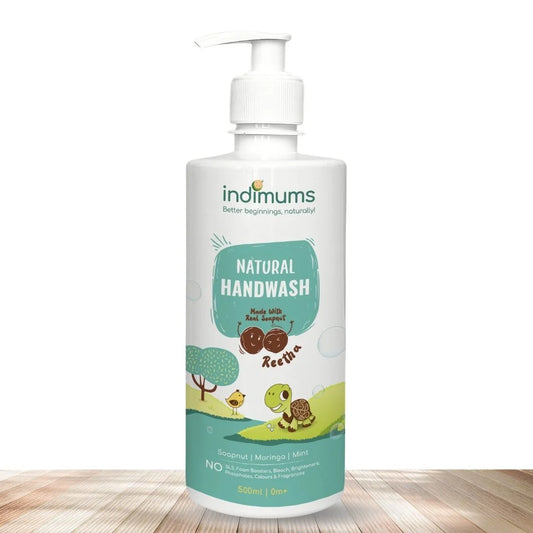
The Indimums Baby Shampoo and Body Wash {#indimums}
Indimums does not make a 2-in-1. That is a deliberate choice.
The Indimums Natural Baby Shampoo is built specifically for the scalp. Reetha (soapnut) saponins cleanse at a baby-suitable pH without stripping sebum. Bhringraj supports follicle nourishment. Shikakai conditions without silicone coating. Aloe vera soothes during washing. Neem gives mild antimicrobial support.
What is not in it: SLS, SLES, parabens, silicones, artificial fragrance, synthetic dyes, formaldehyde-releasing preservatives.
The Indimums Natural Baby Body Wash is built specifically for skin. The same Reetha base cleanses at a pH compatible with infant skin without disturbing the lipid barrier. Aloe vera soothes and hydrates during washing. Neem supports skin exposed to sweat and heat.
What is not in it: SLS, SLES, parabens, phenoxyethanol, artificial fragrance, alcohol, synthetic dyes, triclosan.
Two products. Two surfaces. Neither compromising on the job it was built for.
"Bath time felt clean without that dry tight feeling after rinsing." — Indimums Parent Community
Many parents who use both together notice that scalp and skin respond differently — and better — when each is getting what it actually needs.

The Convenience Is Real — So Is the Trade-off
You started with a reasonable question: does one product actually do both jobs well? The honest answer is sometimes — for a healthy baby with no specific scalp or skin concerns, a well-formulated sulphate-free 2-in-1 can work. The moment a baby's scalp or skin starts signalling — flaking, dryness, buildup, sensitivity — the compromise format stops being the right answer.
Convenience is worth something. Ingredient integrity is worth more. What you leave out matters as much as what you put in.
FAQs
Q1. Are 2-in-1 baby shampoo and body wash products safe?
A1. They can be, if sulphate-free, fragrance-free and pH-balanced. The limitation is formulation compromise — one formula cannot be fully optimised for both scalp and skin. For a healthy baby with no specific concerns, a well-formulated 2-in-1 is acceptable.
Q2. Can a 2-in-1 cause product buildup in baby hair?
A2. Yes. If the cleansing base is too mild for scalp use or contains silicones, repeated use leads to buildup that makes hair feel heavy and look dull. Reducing frequency or switching to a dedicated shampoo usually resolves it.
Q3. Is a 2-in-1 okay for a baby with eczema?
A3. Not ideal. Eczema-prone skin needs a body wash built specifically for barrier support. A shampoo-body wash compromise formula may not have the right lipid support for reactive skin. Separate products give more control.
Q4. Which is better for Indian conditions — 2-in-1 or separate products?
A4. In Indian heat and humidity, scalp sweat and skin sweat create different cleaning needs. A shampoo that handles scalp buildup and a body wash that handles sweat and oil massage residue separately is more precise than one formula doing both.
Q5. Can I use a 2-in-1 on a newborn?
A5. Only if it is specifically formulated for newborn skin — sulphate-free, fragrance-free and pH-balanced. Newborn scalp and skin are at their most permeable. A compromise formula applied daily from birth is a bigger ask on developing skin than separate gentle products.
Q6. At what age can babies switch from a 2-in-1 to separate shampoo and body wash?
A6. There is no fixed age. Switch when the current product stops meeting the scalp and skin needs separately — flaking, dryness, buildup or sensitivity are the signals. Some parents start with separate products from birth. Both approaches can work if the ingredient standard is right.