Saumya, Founder | 4 mins
Outside the house, baby hands collect the day quickly. A swing chain, a biscuit, a car seat, a shoe, then fingers near the mouth. You may not always have a sink nearby, but the hands still need a plan.
Table of Contents
- How to Keep Baby Hands Clean While Outdoors?
- What can I use to clean baby hands?
- Why Outdoor Hand Cleaning Needs Balance
- Are foaming hand washes safer or more effective for toddlers?
- Why is baby-specific hand wash recommended?
- The Indimums Baby Hand Wash
- How It Compares
- The Soap Question Starts at Home
- FAQs
How to Keep Baby Hands Clean While Outdoors?
Quick Answer: Keep baby hands clean outdoors by wiping visible dirt first, washing with a gentle baby hand wash when water is available and avoiding harsh sanitiser as a routine substitute. Clean at key moments without drying the skin.
What can I use to clean baby hands?
Parents worry because outdoor dirt is unpredictable. The World Health Organization supports hand hygiene before eating and after likely contamination. In parent language, timing matters as much as the product. Here is what most people miss: the best outdoor routine is one you can repeat without irritating the skin.
Why Outdoor Hand Cleaning Needs Balance
Exposure variety. Outdoor hands meet dust, sweat, food, public surfaces and toys in a short time.
Skin tolerance. Frequent wiping or sanitising can disturb the moisture barrier, especially on small hands that return to the mouth often.
Are foaming hand washes safer or more effective for toddlers?
- Triclosan - is not needed for everyday baby hand hygiene
- SLS and SLES - can dry hands washed several times a day
- Alcohol-heavy cleansers - can make small hands feel tight
- Synthetic fragrance - adds repeated residue before food and mouthing
- Parabens - are avoidable in frequent-contact products
- Synthetic dyes - add colour without helping cleanliness
None of this means parents need to panic. It only means the ingredient list should do fewer, clearer jobs.
Why is baby-specific hand wash recommended?
- Reetha (soapnut) - cleans without an adult-style harsh feel
- Neem - supports hygiene for hands that touch floors and toys
- Aloe vera - helps comfort after washing
- Glycerin - supports moisture through repeated daily use
- Rinsability - matters because hands go back to the mouth quickly
For Reetha-based cleansing, you can read more about soapnut here.
If this concern feels familiar, the calmer answer is usually a better foundation, not a louder product.
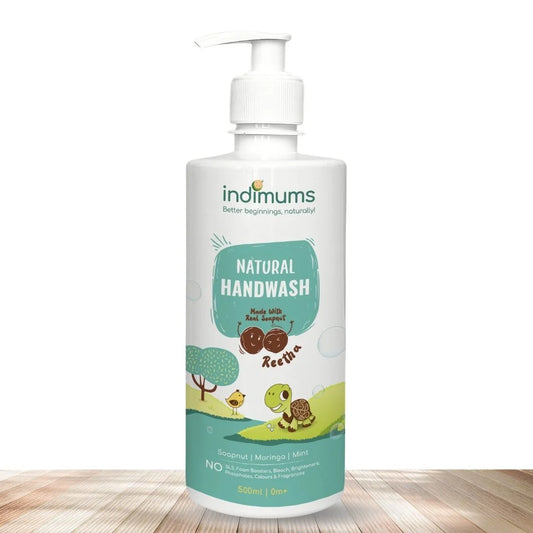
The Indimums Baby Hand Wash
The Indimums Baby Hand Wash is built for this exact kind of baby-care question.
What is in it:
- Reetha (soapnut) - effective plant-based cleansing at infant-skin-compatible pH
- Neem - natural antimicrobial support without triclosan
- Aloe vera - soothes and hydrates through repeated washing
- Glycerin - maintains moisture balance through multiple washes
- Essential oils in safe functional concentrations - avoid synthetic fragrance
What is not in it: SLS, SLES, triclosan, parabens, synthetic fragrance, alcohol, phenoxyethanol, synthetic dyes.
"We could wash his hands more often without them turning rough by evening." - Indimums Parent Community
Many parents who switch notice that the routine feels calmer because the formula is not trying to impress with foam, perfume or coating.

How It Compares
| Aspect | The Indimums Baby Hand Wash | Typical hand wash |
|---|---|---|
| Cleansing or moisturising base | Reetha (soapnut) - effective plant-based cleansing at infant-skin-compatible pH | Usually synthetic surfactant, soap base or heavy coating oil |
| Fragrance | avoid synthetic fragrance | Often built around perfume or strong scent |
| Key active ingredients | Reetha (soapnut), Neem, Aloe vera, Glycerin | Often listed broadly without explaining function |
| Skin, scalp or surface impact | Designed around residue-conscious baby contact | Often designed around adult sensory expectations |
| Suitable for sensitive or newborn skin | Avoids SLS, SLES, triclosan, parabens | May include avoidable fragrance, surfactants or coating agents |
| Preservatives | Avoids phenoxyethanol and parabens | Typical formulas may use stronger preservative systems |
| Philosophy | Foundation-first care that removes what is not needed | More foam, scent or shine is often treated as proof |
The Soap Question Starts at Home
This blog answers how to manage hand cleaning when you are outside. The linked blog explains whether regular hand soap is suitable for babies in the first place. Read it next before deciding what to keep near the sink or in the diaper bag.
Read next: Can You Wash Baby Hands With Hand Soap?
Outdoor hygiene should be steady, not harsh
You began outside, where clean hands are harder to control. The better routine is simple enough to repeat: remove visible dirt, wash at key moments and avoid making hygiene harsh. Baby hands should be ready for food and play without feeling dry by evening. Made for parents who think.
FAQs
Q1. How to keep baby hands clean while outdoors?
A1. Wipe visible dirt first, wash with a gentle hand wash when possible and avoid routine harsh sanitiser use.
Q2. What can I use to clean baby hands?
A2. Use clean water and a baby-suitable hand wash. Wipes can help temporarily until you reach a sink.
Q3. Why is baby-specific hand wash recommended?
A3. It is made for repeated washing without strong surfactants, triclosan or synthetic fragrance.
Q4. Do Indian playgrounds need extra hand cleaning?
A4. Yes. Dust, shared play equipment and snacks make hand cleaning useful before eating or mouthing.
Q5. Are foaming hand washes safer?
A5. Not automatically. Ingredients and rinsability matter more than foam format.
Q6. Can sanitiser replace hand washing?
A6. Not as a routine. Use it only when needed and wash with water when available.