Saumya, Founder | 5 min read
The cycle has finished, but a vest feels stiff or a dark sleepsuit has pale streaks. Another rinse sometimes helps, yet the same thing returns with the next load. That pattern often points to how the laundry is being washed, not simply the number of rinses.
Table Of Contents
- Why Does Detergent Residue Stay On Baby Clothes Even After Rinsing?
- What Has To Happen For Detergent To Rinse Away?
- Why Indimums Thinks Beyond How Clothes Look In The Drum
- How It Compares
- Why Can Water And Machine Settings Change The Result?
- How Can You Tell Whether The Problem Is Actually Detergent?
- FAQs
Why Does Detergent Residue Stay On Baby Clothes Even After Rinsing?
Quick Answer: Detergent can remain when the dose is too high, clothes cannot move freely, powder has not dissolved or rinse water does not circulate and drain properly. Hard-water minerals and softener deposits can look similar. Some fabric treatments are designed to stay on fibres, so not every deposit is ordinary detergent waiting for one more rinse.
What Has To Happen For Detergent To Rinse Away?
The wash needs to distribute the detergent, loosen the soil and then replace the wash water with clean water that reaches the fabric. If a small load receives a large dose or the drum is tightly packed, the rinse has a harder job from the start.
LG's detergent-residue troubleshooting guidance identifies excessive detergent and clumped or poorly dissolved product as possible causes of streaks. More rinsing cannot permanently fix the same dosing mistake being repeated. It helps to correct the wash step as well as the final rinse.
Why Indimums Thinks Beyond How Clothes Look In The Drum
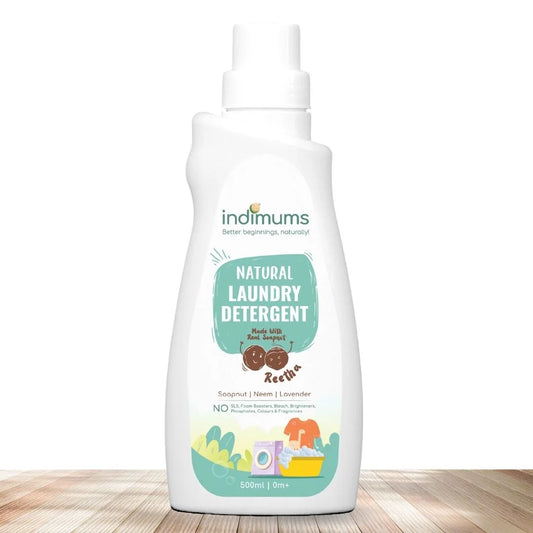
With Indimums Natural Laundry Detergent, we think about the vest against your baby's skin long after wash time. Our Reetha-based formula leaves out optical brighteners because added whiteness is not the benefit we want parents to rely on.
The aim is a straightforward laundry routine centred on removing everyday soil, without treating extra foam or a lasting perfume as proof of success. What matters is the finished garment, not the appearance of the wash water. Thoughtful formulation and a well-run wash need to work together.

Why we make it this way: See how Indimums began and what we believe baby care should do.
How It Compares
| What You Notice | Possible Explanation | Useful Next Check |
|---|---|---|
| Pale Streaks | Undissolved detergent, minerals or other deposits | Dose, dissolution and water conditions |
| Stiff Fabric | Minerals, product deposits or the fabric itself | Compare after a correct wash and rinse |
| Strong Scent | Fragrance retained by the fabric | Scent choices; smell does not measure harm |
| Slippery Or Coated Feel | Possible detergent or softener deposit | Review both detergent and added treatments |
| Very Bright Whites | May include an optical-brightening effect | Ingredient information, not just appearance |
| Problem Across Loads | Dosing or a dispensing or drainage issue | Washer care and programme selection |
| Redness During Wear | Several skin and contact causes are possible | Fabric, fit, dampness and clinical advice if persistent |
Why Can Water And Machine Settings Change The Result?
Hard water can contribute mineral deposits and affect how some detergents work. Cold water can also expose problems with a powder that does not dissolve well under those conditions. Use the detergent's guidance for water hardness and the garment's care instructions, rather than adding an unmeasured extra scoop.
Check that the selected programme suits the load. A short cycle intended for a small, lightly soiled load may be a poor match for a full drum of heavily used baby clothes. A blocked dispenser or drainage problem can also keep disrupting the result even after you change detergent.
How Can You Tell Whether The Problem Is Actually Detergent?
Pale marks, stiffness and a strong scent are clues, not a laboratory identification. Mineral deposits, fabric softener, lint and ordinary wear can produce similar complaints. Notice whether the problem improves when you use a measured dose, a smaller load and an appropriate rinse.
If a garment repeatedly causes redness, take it out of use while you review both the fabric and the wash. A skin reaction does not prove detergent residue is the cause. Continuing symptoms deserve assessment rather than endless re-washing or adding more laundry treatments.
Want A More Reliable Wash From Start To Finish?
A complete routine makes the rinse easier by getting the load size, dose and programme right first. It also helps avoid wasting water on repeat cycles that do not address the cause.
Read The Complete Baby Laundry Routine.
Conclusion: Fix What The Rinse Is Being Asked To Remove
Residue problems often begin before the rinse starts. Dose, dissolution, load size and water movement all influence the result.
Start with those practical checks and distinguish leftover detergent from other deposits. An extra rinse can help, but it should not be the only correction.
FAQs
Q1. Does Residue Always Mean I Need A Stronger Detergent?
A1. No. Too much product or poor distribution can be the problem. Adding a stronger or larger dose may make rinsing harder.
Q2. Can Liquid Detergent Leave Residue?
A2. Yes. Liquid products can also be overdosed or inadequately rinsed. Being liquid does not guarantee a residue-free result.
Q3. Does Hard Water Leave The Same Marks As Detergent?
A3. It can leave pale deposits or stiffness that are easy to confuse with detergent. Appearance alone cannot identify the material.
Q4. Will One Extra Rinse Always Solve It?
A4. No. It may help remove leftover detergent, but persistent problems need dosing, loading, product dissolution and machine function checked.
Q5. Can Fabric Softener Be What I Am Feeling?
A5. Yes. Softeners deliberately change the feel of fibres and can leave deposits. They are different from detergent that failed to rinse out.
Q6. Is Strong Fragrance Proof Of Harmful Residue?
A6. No. Smell does not measure chemical exposure or establish harm. It can still be a reason to review scent choices when the skin is sensitive.