Saumya, Founder | 5 min read
For some families, reetha is not a new ingredient to discover. It is the dried fruit they remember soaking before a hair wash, or a name heard when an older relative explained how things used to be cleaned. The interesting question is not simply why the tradition survived, but what useful job helped it survive.
Table Of Contents
- Why Did Reetha Become A Familiar Household Ingredient?
- What Made Reetha Useful Before It Became A Label Claim?
- How Did Families Pass The Washing Knowledge On?
- What Can Science Explain About The Old Practice?
- How Does Indimums Carry That Familiarity Forward?
- What Is Worth Keeping In Today's Routine?
- FAQs
Why Did Reetha Become A Familiar Household Ingredient?
Quick Answer: Reetha combines a practical cleansing property with a history of household knowledge. Its saponins help water clean, and families passed on ways to prepare and use it. Availability and local custom helped shape those routines, although the same practice was never universal across all Indian homes.
What Made Reetha Useful Before It Became A Label Claim?
An ingredient stays in a household routine more easily when it does something people can observe. Soapnut preparations can foam and help with washing. That gives reetha a practical role beyond a symbolic association with tradition. The plant's usefulness and the knowledge of preparing it belong together.
Familiarity can come from repeated use without proving every later health claim. A remembered hair-washing method does not establish that the same preparation treats scalp disease or suits every newborn. We can explain the cleaning role clearly without attaching outcomes that the family story cannot demonstrate.
How Did Families Pass The Washing Knowledge On?
Household knowledge often travels through observation: which material to choose, how to prepare it and what the wash should feel like. An ethnobotanical paper in the Indian Journal of Traditional Knowledge documented traditional hair-care practices in Gujarat's Sabarkantha district, including a Sapindus preparation. Such records show specific local use rather than a single national recipe.
That distinction matters when we say 'our grandmothers used it'. It can be a truthful memory for one household and unfamiliar to another. Different regions, access to plants and family habits shape different care traditions. There is no need to make every family share one story for the ingredient to have a meaningful history.
What Can Science Explain About The Old Practice?
Modern work on soapnut extracts helps explain the cleansing mechanism: saponins change interactions between water, surfaces and oily material. That explanation connects an observable washing result with the compounds in the fruit. It is more informative than saying reetha worked because earlier generations avoided chemistry.
Laboratory findings and historical records answer different questions. One can describe a physical property; the other can record how people used a plant. Neither automatically proves a finished baby product's suitability. Respecting tradition means being precise about what it tells us, not asking it to do the work of every type of evidence.
How Does Indimums Carry That Familiarity Forward?
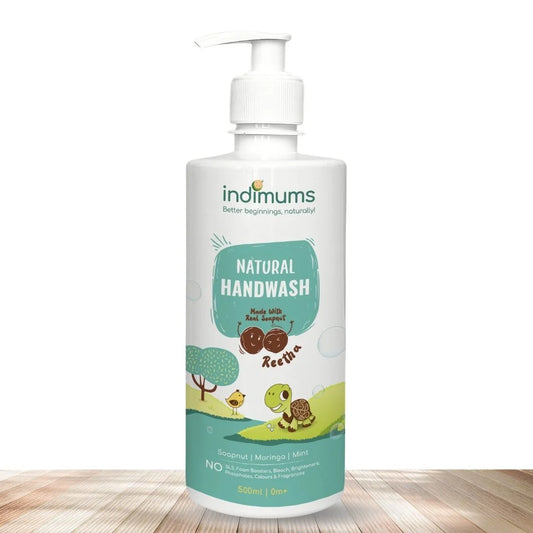
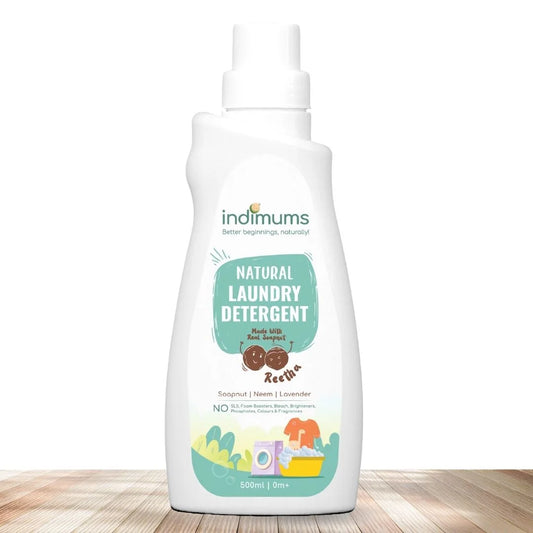
Indimums uses reetha as a recognised botanical with a defined cleansing role. Our Soapnut page describes that connection. We want parents to understand the ingredient they recognise, rather than accept an unexplained promise because the name feels familiar.
Our time-tested and lab-tested philosophy also treats formulation as part of the story. Traditional use can inform ingredient choice, while the prepared product still needs its own assessment. Carrying knowledge forward does not require copying a home recipe unchanged.
What Is Worth Keeping In Today's Routine?
Keep the habit of understanding what an ingredient does. Ask why it is included, how the product should be used and whether it makes the routine manageable. Those questions honour practical household knowledge better than choosing a bottle only because it shows a leaf or promises an ancient secret.
You can also keep the care and conversation around a family ritual while changing the preparation. A product with clear directions may fit your home better than soaking fruit yourself. The point is not to choose a side between past and present; it is to make an informed choice for the person being cared for now.
Explore The Hair-Washing Tradition More Closely
Reetha's broader household history is different from the specific question of washing a baby's hair. That narrower use needs its own discussion of preparation and suitable care.
Read Why Did Indian Grandmothers Use Reetha Instead Of Soap To Wash A Baby's Hair? for that context.
Conclusion: Keep The Useful Knowledge, Not Just The Familiar Name
Reetha's place in household memory has a practical basis: it helped people wash. Local knowledge and repeated use gave that role continuity, even as preparations differed between homes.
Today, we can value the history and still ask careful questions about the formula in front of us. The tradition becomes more useful when we understand it, not when we turn it into a guarantee. Questioning is also care.
FAQs
Q1. Did every Indian household use reetha?
A1. No, traditions varied by region, access and family practice. It is better to describe a documented or remembered use than a universal custom.
Q2. Why was reetha associated with washing hair?
A2. Its saponins give it a practical cleansing role. Household preparation knowledge helped people use that property in hair-washing routines.
Q3. Does traditional use prove baby safety?
A3. It provides historical context, not a complete assessment of a baby product. Concentration, formulation and intended use still matter.
Q4. Is there research documenting traditional hair care?
A4. Yes, ethnobotanical records include local practices involving Sapindus preparations. Those records describe use rather than demonstrating every claimed benefit.
Q5. Must I soak reetha myself to honour the tradition?
A5. No, a family practice can inform your choices without requiring the same preparation method. Choose care that suits the baby and your routine.
Q6. What does time-tested plus lab-tested mean here?
A6. It describes combining traditional ingredient knowledge with assessment of prepared products. It should not be read as a numerical promise of double safety.