Saumya, Founder | 5 min read
When washed clothes feel coated, the instinct is often to wash them again with more product. That can repeat the very problem you are trying to solve. A better reset starts by removing the excess and changing what allowed it to build up.
Table Of Contents
- 5 Tips To Remove Detergent Residue From Baby Clothes Completely
- 1. Re-Rinse The Affected Clothes Without Adding More Product
- 2. Match The Dose To The Actual Load
- 3. Give Water Enough Space To Move Through The Fabric
- 4. Use A Programme That Suits The Clothes And Detergent
- 5. Check The Dispenser And The Next Load
- How Indimums Keeps The Laundry Goal Simple
- FAQs
5 Tips To Remove Detergent Residue From Baby Clothes Completely
Quick Answer: Re-rinse affected clothes without more detergent, correct the dose, give the load room, use a suitable programme and check the washer. These steps help remove leftover detergent and prevent recurrence. They cannot certify absolute zero residue at home or guarantee removal of every fabric treatment.
1. Re-Rinse The Affected Clothes Without Adding More Product
If the laundry is otherwise clean but appears to hold excess detergent, use an appropriate rinse-and-spin cycle with no added detergent or softener. For handwashing, drain the old water and rinse the fabric in fresh clean water, allowing water to move through it.
Do not keep topping up the same soapy basin and expect it to become a fresh rinse. Removing the wash liquid is part of rinsing. If the garment is still soiled, it needs a proper wash rather than a rinse-only shortcut.
2. Match The Dose To The Actual Load
Measure detergent for the load, level of soiling and water hardness, using the product and washer guidance. A handful of baby clothes does not necessarily need the same dose as a full family load. Check concentrated formulas particularly carefully.
Do not guess that half a cap is always right or reduce detergent so far that cleaning suffers. The useful target is the appropriate dose, not the smallest imaginable amount. If residue repeatedly follows your usual measurement, review that measurement before repeating the cycle.
3. Give Water Enough Space To Move Through The Fabric
Avoid packing the drum tightly. Follow its loading guidance so clothes can move and clean water can reach the folds. For handwashing, work with manageable batches rather than squeezing everything into a small bucket.
Samsung's laundry troubleshooting guidance advises against overloading because it compromises washing performance. A smaller, properly washed load can be more practical than a full load that needs repeated attention. Do not compensate for a crowded wash with more detergent.
4. Use A Programme That Suits The Clothes And Detergent
Check the fabric's allowed temperature and the detergent's instructions for use. If powder stays clumped or does not dissolve under the chosen conditions, resolve that before the next load. Avoid improvising hot washes for delicate garments simply to chase away a mark.
Do not add vinegar, bleach, baking soda or several products together as a default residue treatment. They are not interchangeable fixes, and mixing cleaning chemicals can be dangerous. Use the rinse process and any manufacturer-approved maintenance method instead.
5. Check The Dispenser And The Next Load
Clean the dispenser and carry out washer maintenance as its manual directs. If drainage or dispensing seems faulty, have that checked. Deposits returning across different loads can be a machine issue rather than proof that every detergent is unsuitable.
Once clothes are fully dry, check whether obvious streaks or a coated feel remain. Smell, foam and softness cannot prove molecular zero. If the problem persists, investigate the material rather than repeating unlimited rinses; mineral deposits or fabric treatments may need a different explanation.
How Indimums Keeps The Laundry Goal Simple
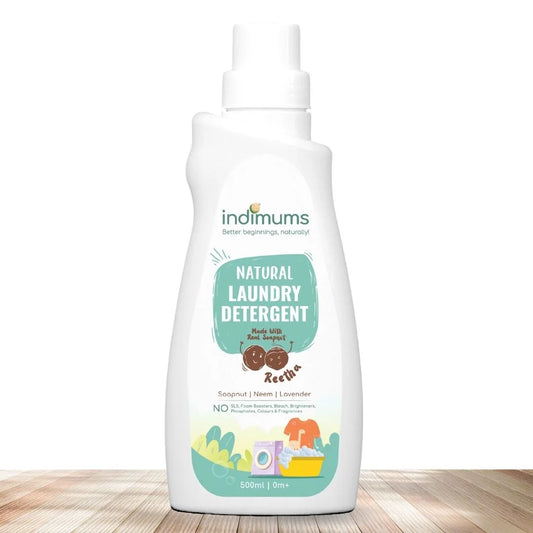
Our approach with Indimums Natural Laundry Detergent is to focus on clothing that comes back ready for everyday wear, rather than an impressive-looking wash. The Reetha-based formula is made without optical brighteners, so extra whiteness is not the finish we ask parents to chase.
For a household already managing feeds, sleep and frequent changes, the benefit we aim for is a clear, repeatable routine. Clean the clothing, rinse well and judge it after drying. The purpose is practical care for something your baby wears for hours, not another layer of laundry add-ons.

Why we make it this way: See how Indimums began and what we believe baby care should do.
Still Comparing Liquid And Powder?
Either format can work when matched to the machine and washing conditions. The format alone does not settle whether your load will rinse well.
Read Liquid Vs Powder Baby Laundry Detergent.
Conclusion: Remove The Excess And Prevent The Repeat
A fresh-water rinse can help with leftover detergent, but the next load needs a better dose and enough room to wash properly.
Keep the process simple and investigate persistent deposits instead of adding more products. The goal is effective washing and rinsing, not an unprovable zero-residue promise.
FAQs
Q1. Should I Add Detergent When Re-Rinsing Residue?
A1. No, not when the clothes are already clean and you are removing leftover detergent. Add no new detergent or softener for that rinse.
Q2. How Many Rinses Guarantee Complete Removal?
A2. There is no fixed number that guarantees zero residue for every fabric, product and machine. Correct the cause rather than relying on a universal count.
Q3. Can I Use Vinegar With Bleach To Remove Deposits?
A3. No. Never mix bleach with vinegar or other acids, because dangerous gases can be produced.
Q4. Should I Wash All Baby Clothes In Very Hot Water?
A4. No. Follow garment care and relevant hygiene instructions. Excess heat can damage fabrics and is not a universal solution to residue.
Q5. Will Brighteners Wash Out Like Extra Detergent?
A5. Not necessarily. Some are intended to attach to fibres, so ordinary extra rinsing cannot be assumed to remove them fully.
Q6. Can I Keep Using Clothes That Seem To Trigger Redness?
A6. Take the suspected garment out of use while reviewing the wash and fabric. Persistent or recurring skin irritation should be assessed.