Saumya, Founder | 4 mins
The biscuit is on the floor before you can catch it. Your baby reaches down, picks it up, and those fingers head straight back towards their mouth. At the sink, the adult hand wash is already within reach. Baby hand wash vs adult hand wash suddenly feels less like a shopping question and more like a decision you make several times before lunch.
Table of Contents
- Baby Hand Wash Vs Adult Hand Wash: Why Does The Formula Difference Matter?
- Which Formula Differences Matter In Baby Vs Adult Hand Wash?
- How Indimums Baby Hand Wash Supports Repeated Daily Washing
- How It Compares
- Does A Baby Need An Antibacterial Hand Wash?
- How Can Repeated Handwashing Stay Gentle On Baby Skin?
- Can Your Baby Use The Same Hand Wash As The Family?
- FAQs
Baby Hand Wash Vs Adult Hand Wash: Why Does The Formula Difference Matter?
Quick Answer: For daily use, choose a mild hand wash that removes dirt, rinses easily and leaves your baby's hands comfortable. The formula difference matters most in the cleansing blend, fragrance and how skin feels after repeated washing. A mild adult wash can also fit those needs; compare the ingredients and your baby's response rather than choosing by the age label alone.
Which Formula Differences Matter In Baby Vs Adult Hand Wash?
Both products use cleansing ingredients to help water remove grease, dirt and microbes. The bottle colour does not change that job. What can differ is the cleanser blend, fragrance, pH, conditioning ingredients and directions for use. Some adult washes are mild and fragrance-free. Some children's washes include strong scents and colour. Compare the formulation, not the age pictured on the packaging.
Surfactants are ingredients that help oily material mix with water so it can rinse away. Their names alone cannot predict the finished product's mildness: concentration and the way ingredients are combined matter. A soap-based formula and a soap-free cleanser can also have different pH levels. Skin comfort depends on the whole wash, the quantity used, water temperature and how often the routine repeats.
At home, notice what happens after drying. Comfortable hands that move normally tell you more than a large foam cloud. Tightness, stinging, rough knuckles or repeated redness are reasons to review the routine. Those signs do not identify a single guilty ingredient by themselves, but they do mean the current combination of washing and skin care needs attention.
How Indimums Baby Hand Wash Supports Repeated Daily Washing
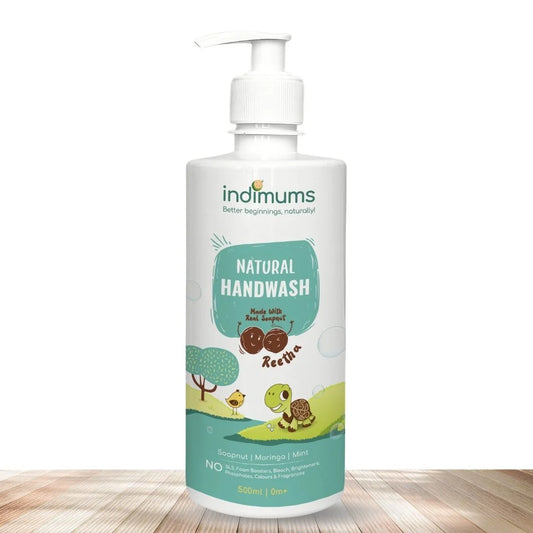
The Indimums Natural Handwash uses Reetha and Shikakai to help lift everyday dirt during washing. Reetha's plant-derived saponins help water carry away oily soil, while Shikakai forms part of the cleansing blend. Moringa leaf extract adds to the botanical formula, and mint essential oil gives it a light aromatic finish.
We build the routine around the moments little hands need cleaning: before a meal, after messy play and when dirt comes home from outdoors. A manageable amount, a thorough rinse and gentle drying help make that habit easy to repeat. The formula contains no synthetic fragrance, although its mint oil gives it a natural scent. The aim is clean hands that feel comfortable when your baby returns to eating, playing and exploring.
Make everyday handwashing simpler with a formula built for little hands and their busy routines.

How It Compares
The comparison describes formulation choices, not a test or ranking of every product in the category. Check the individual label.
| Aspect | Indimums Hand Wash | Other Adult Hand Washes |
|---|---|---|
| Cleansing base | Reetha and Shikakai in a formulated wash | Soap or other surfactant blends; inspect the label |
| Fragrance | Contains mint essential oil | Fragrance-free and scented options both exist |
| Key ingredients | Moringa extract alongside plant cleansers | Conditioners and botanical additions vary |
| Skin impact | Suitability depends on individual tolerance and correct use | Mild formulas can suit children; stronger ones may not |
| Sensitive skin | Not automatically suitable for fragrance allergy | Fragrance-free options may be preferable |
| Preservation | Potassium sorbate in the supplied ingredient list | Preservative system depends on formulation |
| Approach | Clear ingredients and supervised everyday washing | Adult positioning does not by itself establish mildness |
Does A Baby Need An Antibacterial Hand Wash?
For routine household handwashing, the CDC reports no added health benefit from consumer antibacterial soap over plain soap. The practical job is to loosen contamination, rub all hand surfaces and rinse it away. A stronger claim on the label cannot make up for a rushed wash that misses thumbs and fingertips.
This matters when a parent worries that a gentle product might be too gentle to work. Mildness and useful cleaning are compatible goals. Cleaning performance must come from the finished formula and correct use, rather than scent strength or a botanical's laboratory reputation. Mint, neem or another plant ingredient should not be described as equivalent to a tested antibacterial medicine merely because it has been studied in isolation.
Keep disinfecting wipes for their labelled surface uses. They are not a substitute for washing a baby's hands. If soap and water are unavailable, follow age-appropriate public-health advice on supervised hand sanitiser use and prevent swallowing; a baby should never handle the bottle independently.
How Can Repeated Handwashing Stay Gentle On Baby Skin?
Make the sink routine easy to finish. Wet the hands, use the labelled amount, and help rub palms, backs, fingers and thumbs for about 20 seconds. Rinse with clean running water and dry gently. For a baby who cannot stand, support them securely; bringing a suitable basin within reach is safer than balancing them on the edge of the sink.
Wash at meaningful moments, including before eating and after visibly dirty play. Caregivers also need clean hands before food preparation and after diaper changes. Constantly washing a baby's hands after every harmless touch can add friction without a clear benefit. The aim is to interrupt relevant contamination routes while keeping the routine realistic for your household.
Indian weather can complicate the picture. A hot afternoon may mean dusty outdoor play, while air conditioning later makes already dry skin feel tighter. Avoid compensating with hotter water or extra pumps. If hands need moisturiser, choose an age-appropriate product compatible with any medical advice, and address cracks or ongoing irritation rather than washing through discomfort.
Can Your Baby Use The Same Hand Wash As The Family?
A family wash can be a practical option when its directions allow the intended use and its formula suits the child's skin. Look for mild cleansing and, especially for reactive skin, fragrance-free options. There is no universal birthday when a child's hands suddenly require an adult-style formula. Existing tolerance, skin condition and how the product is used are more helpful guides.
Introduce one change at a time. If you replace the soap, towel detergent and moisturiser together, it becomes harder to work out why irritation appeared. Stop a new product that causes discomfort and ask a clinician about persistent symptoms. Swelling, spreading redness, weeping or painful cracks deserve assessment rather than another round of trial-and-error shopping.
When Washing Leaves More Than Clean Hands
This comparison explains how to assess the wash you keep beside the sink. Our article on dry, cracked baby hands addresses what to check once discomfort has already appeared. It is the useful next step if the problem is now skin recovery as well as choosing a cleanser.
Read next: Baby Hands Dry and Cracked After Washing — Is the Hand Wash Too Strong?
Conclusion: Let Comfortable Hands Guide The Choice
The next time those biscuit-covered fingers arrive at the sink, you do not need to decide by the word baby alone. Read the formula, help the wash reach every part of the hands and give rinsing the time it needs. A routine that removes relevant dirt while keeping skin comfortable is a stronger foundation than repeatedly correcting dryness after washing. Your child's response remains part of the decision, even when a label sounds reassuring. What you leave out matters as much as what you put in.
FAQs
Q1. Can I use adult hand wash on my baby?
A1. A mild adult wash may be suitable if its directions permit that use and your baby's skin tolerates it. Check fragrance and the complete formulation, supervise washing and rinse thoroughly.
Q2. Is baby hand wash always gentler?
A2. No, the baby label does not establish how mild the finished formula is. Ingredients, their concentrations and the washing routine all influence tolerance.
Q3. Does mint in hand wash replace antibacterial ingredients?
A3. Mint's presence does not prove that a finished product has antibacterial performance. Everyday hygiene depends on an effective wash used correctly, including rubbing and rinsing.
Q4. How long should I help my child wash their hands?
A4. Aim for about 20 seconds of rubbing all hand surfaces before rinsing. Younger babies need hands-on support so they remain secure and do not swallow the cleanser.
Q5. Why do my baby's hands feel rough after washing?
A5. Frequent washing, hot water, friction or an unsuitable formula may contribute. Persistent roughness, painful cracks or redness should be discussed with a clinician.
Q6. Should I change hand wash at a particular age?
A6. There is no fixed age that makes an adult formula necessary. Choose according to the product directions, skin condition and your child's response.