Saumya, Founder | 4 mins
The sleepsuit smells freshly washed, yet your baby starts rubbing at the neck after getting dressed. You check the seam, loosen the fastening and wonder about the last laundry load. Choosing the best baby laundry detergent in India for sensitive skin is about more than the softness of clean clothes. The ingredients and the washing routine both deserve a place in that decision.
Table of Contents
- Which Baby Laundry Detergent Ingredients Matter For Sensitive Skin In India?
- What Should You Check Beyond The Sensitive-Skin Claim?
- How Indimums Laundry Detergent Fits Everyday Baby Clothes Care
- How It Compares
- What Should You Check Beyond The Sensitive-Skin Claim?
- FAQs
Which Baby Laundry Detergent Ingredients Matter For Sensitive Skin In India?
Quick Answer: For sensitive skin, start with effective cleaning, clear dosing and good rinsing; fragrance-free and dye-free formulas are especially useful when eczema or fragrance sensitivity is involved. The detergent should suit your machine and water conditions. A baby label or botanical ingredient is helpful context, but your baby's comfort in the washed fabric is the practical result to watch.
What Should You Check Beyond The Sensitive-Skin Claim?
Read fragrance and colour information first when those are known concerns. Unscented does not always mean fragrance-free, and an essential oil still contributes aromatic compounds. If a clinician has recommended fragrance-free laundry, a naturally scented product is not an equivalent replacement simply because its scent comes from a plant.
Next, check machine compatibility and dosing information. Hand-wash instructions do not necessarily transfer directly to a front-loading machine. Concentrated products also differ in the amount needed. A label that explains how much to use is more useful than a long list of reassuring adjectives with no practical directions.
Preservation and cleaning ingredients serve different roles. Potassium sorbate, for example, is included to help protect a formula during storage, not to remove a food stain. Ingredients should be assessed for their actual function rather than divided into familiar and unfamiliar names. Botanical origin does not remove the need for a stable, correctly used product.
How Indimums Laundry Detergent Fits Everyday Baby Clothes Care
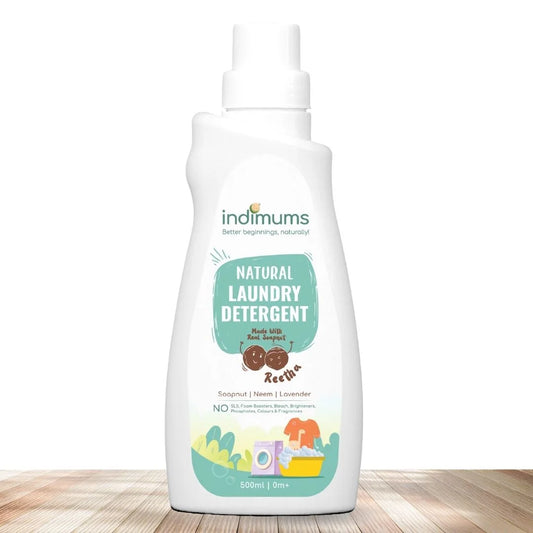
The Indimums Natural Laundry Detergent uses Reetha and Shikakai as part of its fabric-cleaning blend. Reetha's saponins help lift everyday soil into the wash water, while Shikakai contributes to the botanical cleansing approach. Neem seed extract is included in the formula, and lavender essential oil gives it a light natural scent.
We leave out SLS, synthetic fragrance and optical brighteners, concentrating on the everyday job of washing baby essentials. Measure the dose, give the load room to move and let the clothes dry completely before storing them. The formula is naturally scented rather than fragrance-free. For families it suits, the aim is a clear, repeatable laundry routine that works around real spills, small garments and frequent changes.
Make everyday baby laundry more considered with the Indimums fabric-cleaning formula.

How It Compares
Compare these label and routine details across detergents; individual formulas and a baby's tolerance can differ.
| Aspect | Indimums Laundry Detergent | Other Baby Laundry Detergents |
|---|---|---|
| Cleaning base | Reetha and Shikakai in the blend | Different surfactant systems are used |
| Fragrance | Lavender essential oil; no synthetic fragrance | Fragrance-free and scented products are available |
| Key ingredients | Neem seed extract alongside the cleansers | Enzymes, builders and other components vary |
| Fabric care | Use the labelled amount and rinse well | Performance depends on dose, load and water |
| Sensitive-skin fit | Naturally scented; individual tolerance matters | Fragrance-free may better fit eczema guidance |
| Preservation | Potassium sorbate is listed | Preservative systems vary by formulation |
| Approach | No SLS or optical brighteners | Assess the complete label and washing instructions |
Why Does Detergent Choice Matter After The Clothes Are Dry?
A sleepsuit stays against skin through feeds, naps and movement. If a child is sensitive to a laundry ingredient, that repeated contact can be relevant. But a rash after dressing is not proof that detergent caused it: heat, fabric, friction and an existing skin condition can also contribute. Look at the pattern before replacing every item in the cupboard.
The American Academy of Dermatology recommends fragrance-free and dye-free laundry detergent for children with eczema. That gives parents a useful selection point without claiming that every scented wash causes irritation. Sensitive skin is an individual response, so a formula that works for one household may not suit another.
Cleaning and rinsing need to work together. Too much detergent or an overloaded drum can make a good product harder to rinse properly. Using too little may leave soil behind. Start with the manufacturer's dose for the load and water conditions rather than treating an extra capful as extra protection.
The Detergent Format Changes The Practical Routine Too
This article has focused on ingredients and sensitive-skin considerations. Our liquid-versus-powder comparison looks at format and rinsing in more detail. Read it next if you understand what you want on the label but are deciding which form best suits your machine and loads.
Read next: Liquid vs Powder Baby Laundry Detergent — Which Rinses Cleaner From Baby Clothes
Conclusion: Comfortable Clothes Start With A Measured Wash
When that sleepsuit comes out of the cupboard again, there is more to consider than a fresh smell. A suitable formula, a measured dose and complete drying work together to make clothing comfortable through the day. Supporting your baby's skin begins with these repeatable details, rather than correcting every reaction with another strongly scented wash. Notice what changes, keep the routine understandable and seek advice when symptoms persist. The best choice is the one that fits both the laundry and the baby wearing it. Better beginnings naturally.
FAQs
Q1. Which baby detergent is best for sensitive skin?
A1. Look for effective cleaning and clear dosing, with fragrance-free and dye-free options particularly relevant to eczema. The right product also needs to suit the machine, water and your baby's response.
Q2. Is naturally scented detergent fragrance-free?
A2. No, essential oils still provide scent. A naturally scented formula does not meet a specific fragrance-free recommendation.
Q3. Should I use extra detergent on baby clothes?
A3. Use the recommended dose for the load and water conditions. Extra detergent can make rinsing harder without necessarily improving the wash.
Q4. Are enzymes always unsuitable for baby laundry?
A4. No, enzymes serve a cleaning role and are not automatically unsuitable for every baby. Consider the finished product and individual tolerance rather than the category alone.
Q5. Why do washed clothes smell musty?
A5. Incomplete drying or damp storage can be responsible. Check drying conditions and the wash routine before adding more fragrance or detergent.
Q6. Can a rash after dressing prove a detergent allergy?
A6. No, clothing friction, heat and skin conditions can also cause symptoms. Persistent or recurring irritation deserves assessment rather than a diagnosis based on timing alone.