Saumya, Founder | 8 mins
It is easy to pour a little extra detergent when the clothes are tiny and the stains are not. Milk. Sweat. Spit-up. Diaper leaks. But baby laundry detergent works best when the amount is right, not when the scoop is fuller.
Table of Content
- How to choose baby laundry detergent for newborn clothes?
- What is the safest laundry detergent for babies?
- Difference between baby laundry detergent and regular?
- What ingredients to avoid in baby laundry soap?
- Which baby laundry detergent is safest for sensitive skin?
- The Indimums way to dose baby detergent
- How It Compares
- Amount only works when ingredients make sense
- FAQs
- The right amount leaves less behind
How to choose baby laundry detergent for newborn clothes?
Quick Answer: Use the amount of baby laundry detergent recommended for your load size and water level, not extra for reassurance. Too much detergent can leave residue in fabric. Baby clothes need enough cleaning power to remove stains and sweat, then a rinse that leaves fabric quiet.
What is the safest laundry detergent for babies?
Parents often add more detergent because baby stains feel more serious. The American Academy of Pediatrics notes that baby skin can react when irritants sit close to the skin. In parent language, that means the routine should solve the real problem without adding residue, fragrance or daily overuse.
Here is what most people miss: extra detergent can create the very residue you were trying to avoid.
Difference between baby laundry detergent and regular?
Concentration.
Concentrated detergent needs smaller amounts. More liquid does not always mean more cleaning.
Rinse quality.
A clean rinse leaves fabric soft without a strong scent or slippery feel.
What ingredients to avoid in baby laundry soap?
- Synthetic fragrance: can sit in fabric after rinsing
- Optical brighteners: make clothes look brighter without helping skin
- Sulphates: can leave a harsher wash feel
- Phosphates: unnecessary for baby clothing routines
- Fabric softener chemicals: coat fabric for feel, not skin comfort
- Too much detergent: residue matters more than foam
If you have been using extra, reduce slowly and see how the clothes rinse.
Which baby laundry detergent is safest for sensitive skin?
- Reetha: cleans stains without synthetic surfactant residue
- Shikakai: supports cleaning and fabric softness
- Neem: supports clothing hygiene
- Fragrance-free or functional essential oil only: keeps scent low
- Food-grade preservative: keeps the formula stable
- Easy-rinse formula: matters for clothes touching baby skin
If fabric feels slick after washing, the dose may be too high. For Reetha-based routines, the soapnut story matters because it explains why mild cleansing does not need harsh foam.
The Indimums way to dose baby detergent
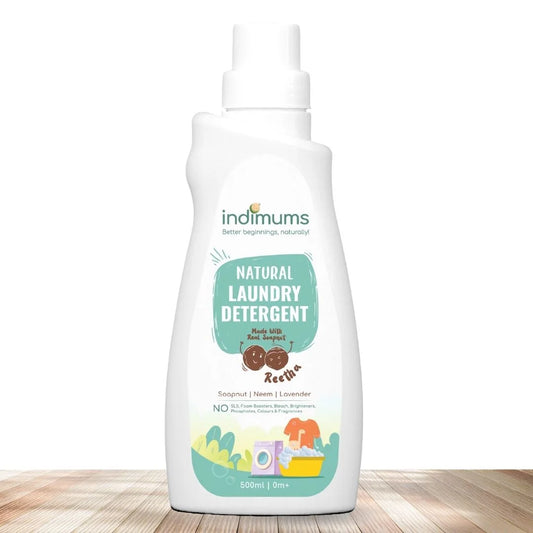
The Indimums Baby Laundry Detergent is made for parents who want a routine that begins with the baby, not the shelf. It is meant to clean with a measured amount, not a perfume-heavy overload.
What is in it: Reetha removes stains without synthetic surfactant residue; Shikakai works with Reetha to clean while keeping fabric softness; Neem gives natural antimicrobial support for clothing hygiene; Lavender essential oil is functional, not synthetic fragrance; Potassium sorbate is food-grade and keeps the formula stable.
What is not in it: synthetic fragrance, optical brighteners, sulphates, parabens, phosphates, fabric softener chemicals, synthetic dyes.
"A smaller amount cleaned well and rinsed out better." - Indimums Parent Community
Many parents who switch notice that the routine feels calmer, cleaner and easier to trust.
How It Compares
| Aspect | Indimums Baby Laundry Detergent | Typical Baby Laundry Detergent |
|---|---|---|
| Cleansing or moisturising base | Reetha and Shikakai clean fabric without synthetic surfactant residue | Synthetic surfactant-heavy base |
| Fragrance | Lavender essential oil is functional, not perfume-led | Synthetic fragrance can remain in fabric |
| Key active ingredients | Reetha, Shikakai, Neem and potassium sorbate named clearly | Actives often hidden behind generic cleaning terms |
| Skin or scalp impact | Made to reduce residue against baby skin | May leave scent or softener coating |
| Suitable for sensitive or newborn skin | Useful for newborn and sensitive skin laundry routines | Often made for family laundry first |
| Preservatives | Potassium sorbate keeps formula stable | May use phosphates or brightener systems |
| Philosophy | Clean clothes should support skin, not just smell fresh | Focuses on fragrance, foam and visible brightness |

Amount only works when ingredients make sense
This blog answered how much detergent to use. The next question is what ingredients belong in that detergent. Reading that next helps you choose a formula where the right dose can actually rinse clean.
Read next: Baby Laundry Detergent Ingredients Parents Should Check
FAQs
Q1. How much detergent should I use for baby clothes?
A1. Use the label amount for load size and water level. Avoid adding extra for small baby loads.
Q2. What is the safest laundry detergent for babies?
A2. One that cleans well at the right dose and avoids fragrance, brighteners and harsh residue.
Q3. Which baby laundry detergent is safest for sensitive skin?
A3. Choose low-residue detergent and rinse thoroughly.
Q4. Does more detergent clean poop stains better?
A4. Not always. Pre-rinsing and correct dosing usually work better than over-pouring.
Q5. Does hard water in India change detergent amount?
A5. It can affect washing, but start with label guidance and rinse quality before adding more.
Q6. Can detergent residue cause rough fabric?
A6. Yes. Too much detergent can leave fabric stiff, scented or coated.
The right amount leaves less behind
You began with a laundry scoop and the instinct to add a little more for baby clothes. That instinct comes from care, but the better answer is measured. Baby laundry works when stains lift and the fabric rinses clean without carrying extra formula back to the skin. Foundation > Fix. Use enough, not more. A quiet rinse is often the sign that the detergent did its job.