Saumya, Founder | 4 mins
We used to think a clean baby vest was easy to recognise: no stain, no smell, folded back into the drawer. Then we paid closer attention to what stayed after washing. A perfume that clung to the sleeve. A towel that felt rough after drying. Fabric that looked clean but still carried the wash with it. That is where the separate-detergent question begins.
Table of Contents
- What We Looked For When We Tested Residue
- Why Baby Clothes Make Residue A Different Question
- How Indimums Laundry Detergent Is Built For Long Fabric Contact
- How It Compares
- How To Reduce Residue In Any Baby Load
- FAQs
Why Do Baby Clothes Need A Separate Detergent?
Quick Answer: Baby clothes can benefit from a separate detergent because they stay against delicate skin for hours and are washed often. A baby-focused formula avoids ingredients such as synthetic fragrance, optical brighteners and fabric-softener chemicals that may remain in fabric after the visible dirt has gone.
What We Looked For When We Tested Residue
Residue is not always a white mark you can see. It can be the strong scent that stays after drying, a stiff towel, a slippery collar or the feeling that a shirt needs another rinse even when it looks clean. These signs do not diagnose every product or every machine, but they tell you the wash has left something behind.
We also found that quantity changes the result quickly. A cap filled to the line can be more detergent than a small baby load needs. Hard water, a packed drum or a short cycle can make even a familiar detergent rinse poorly. The residue question is therefore about formula and about the routine around it.
Why Baby Clothes Make Residue A Different Question
Baby clothes are not worn for a commute and taken off at night. They hold against the neck during feeds, the waist under a diaper and the back during sleep. Baby skin is still developing its barrier, so the repeated contact with fabric deserves a gentler calculation than an adult shirt washed once a week.
Synthetic fragrance can make a load feel “fresh,” but freshness is not the same as clean. Optical brighteners make fabric look whiter without lifting another stain. **For baby clothes, the most useful finish is often the one that does not keep announcing the detergent after the rinse.**
How Indimums Laundry Detergent Is Built For Long Fabric Contact
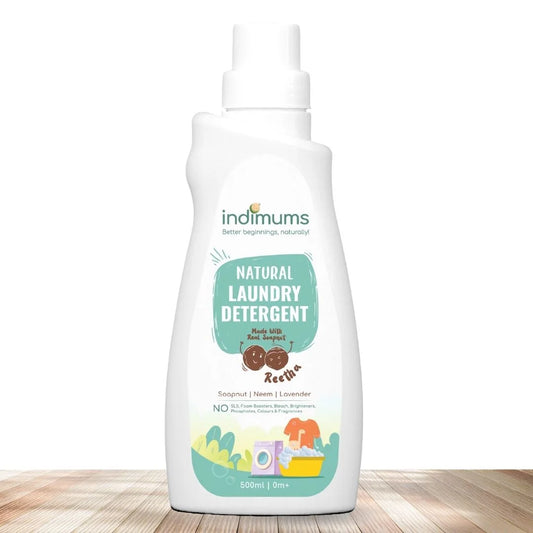
The Indimums Natural Laundry Detergent was formulated around what baby fabric needs after the wash, not just how it looks inside the machine. Reetha helps lift everyday stains and odours, Shikakai works alongside it for fabric cleaning, and Neem seed extract supports the formula’s hygiene focus. Potassium Sorbate keeps the formula stable without adding a heavy fragrance story.
We leave out SLS, synthetic fragrance, optical brighteners, parabens and fabric-softener chemicals. The result is designed to clean the load and make rinse quality easier to trust, rather than asking scent to become proof.

How It Compares
| Aspect | Regular Laundry Detergents | Indimums Baby Laundry Detergent |
|---|---|---|
| Cleaning base | May pair synthetic surfactants with high-scent additives | Reetha and Shikakai support daily fabric cleaning |
| Fragrance | Synthetic perfume may remain through drying | No synthetic fragrance |
| Fabric appearance | May use optical brighteners for a whiter-looking result | No optical brighteners |
| Long skin contact | May be designed around general family laundry | Built with baby clothes and bedding in mind |
| Philosophy | Freshness can be presented as scent | The useful finish is a clean, clear rinse |
How To Reduce Residue In Any Baby Load
Use a small measured dose, separate heavily soiled items and do not overcrowd the machine. Give the rinse cycle enough room and time to move water through the fabric. If a load smells strongly of detergent or feels stiff, rewash with less product and add an extra rinse instead of adding fabric softener.
Air-dry fully when weather allows and do not leave damp laundry sitting in the machine, where mustiness can create a different problem. A separate baby detergent works best when the routine around it is equally simple.
Ingredient Lists Matter After The Wash, Too
This article explains why residue is a fabric-contact issue rather than only a laundry-room issue. The next read breaks down the detergent ingredients worth noticing when you are choosing a formula for baby clothes and bedding.
Read next: Baby Laundry Detergent Ingredients Parents Should Check
Conclusion: Baby Clothes Should Feel Like Clothes, Not Detergent
The reason to choose a separate detergent is not to make the laundry routine more precious. It is to remove a few unnecessary layers from the things that sit on your baby’s skin all day. A clear formula, a modest dose and a complete rinse can do more than a strong perfume ever will. Made for parents who think. The best laundry finish is the one your baby barely has to notice.
FAQs
Q1. Why do baby clothes need separate detergent?
A1. Baby clothes sit against more permeable skin for long stretches and are washed frequently. A separate detergent can help you avoid strong fragrance, optical brighteners and fabric-softener chemicals that are unnecessary for those loads.
Q2. Can regular detergent cause baby skin irritation?
A2. It can contribute when fragrance, residue or strong surfactants remain in fabric, though skin irritation has many possible causes. If a rash persists or worsens, speak with a paediatrician rather than assuming laundry is the only reason.
Q3. What is detergent residue on baby clothes?
A3. Residue is detergent, fragrance, softener or undissolved material that does not fully rinse from fabric. It may show up as stiffness, a strong scent, a slippery feel or no obvious visual sign at all.
Q4. Are optical brighteners safe for baby clothes?
A4. Optical brighteners are not necessary to clean baby clothing; they make fabric appear brighter. Parents who want a simpler formula for long skin contact often choose detergent without them.
Q5. How can I remove detergent residue from baby clothes?
A5. Run an extra rinse, reduce the detergent dose and avoid overfilling the machine. If scent or stiffness remains, wash the load again with less detergent rather than adding fabric softener.
Q6. Do I need baby detergent for all family laundry?
A6. Start with the clothes, bedding and towels that touch your baby most often. Some families choose the same mild formula for everyone to simplify the routine, but the decision depends on your household needs.