Saumya, Founder | 5 min read
A white vest can come out looking brighter without every change in its appearance coming from dirt removal. Some detergents include ingredients specifically for that visual effect. Understanding their job helps separate a brighter-looking garment from a better-cleaned one.
Table Of Contents
- Why Do Baby Laundry Detergents Contain Optical Brighteners?
- How Do Brighteners Make A Vest Look Whiter?
- Why Indimums Focuses On Cleaning Rather Than Added Whiteness
- How It Compares
- Should Parents Avoid Every Detergent With Brighteners?
- What Wording Should You Look For On The Bottle?
- FAQs
Why Do Baby Laundry Detergents Contain Optical Brighteners?
Quick Answer: Some baby laundry detergents contain optical brighteners to make clothes appear whiter and less yellow. They change how fabric interacts with light rather than removing stains themselves. Not every baby detergent contains them, and they are not necessary for cleaning. Their presence alone does not prove a product will irritate a baby's skin.
How Do Brighteners Make A Vest Look Whiter?
Optical brighteners absorb ultraviolet light and emit visible blue light, which can counter a yellowish appearance. India's INFLIBNET textile-learning material explains this as an optical effect. It is different from lifting milk, oil or dirt out of the fibres.
Some brighteners are designed to attach to fabric during laundering so the effect remains after drying. That is an intended fabric treatment, not the same problem as a clump of undissolved detergent. Repeating a rinse is therefore not a reliable way to undo every brightening effect.
Why Indimums Focuses On Cleaning Rather Than Added Whiteness
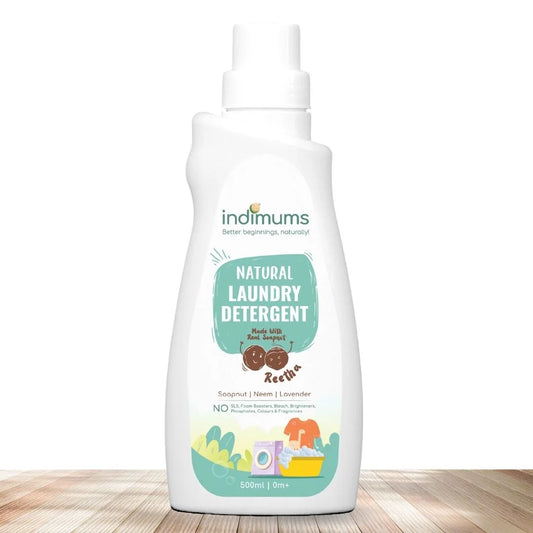
With Indimums Natural Laundry Detergent, our priority is the clothes your baby wears through feeds, naps and play. Reetha and Shikakai form part of the cleaning formula, while optical brighteners are left out. We want the wash to address everyday dirt, not make added whiteness the measure of success.
For parents, that means one less appearance-focused treatment to factor into the laundry routine. A slightly faded but properly washed vest can still do its job perfectly well. Our philosophy is to judge laundry by practical cleanliness and comfort, rather than how bright it looks beside a new garment.

Why we make it this way: See how Indimums began and what we believe baby care should do.
How It Compares
| Aspect | Optical Brightening | Cleaning The Fabric |
|---|---|---|
| Main Job | Changes how white or bright fabric appears | Removes soil from the garment |
| Mechanism | Fluorescence changes the visible light effect | Cleansing action helps loosen and remove soil |
| Milk Stains | Does not itself remove the milk soil | Needs a suitable wash and stain handling |
| After Rinsing | Some brighteners remain associated with fibres by design | Wash solution should be rinsed away |
| Proof Of Hygiene | Whiteness does not establish hygiene | Cleaning still depends on the complete process |
| Skin Response | Presence alone cannot diagnose irritation | Tolerance depends on the fabric and full routine |
| Indimums Approach | No added optical brighteners | Reetha-based formula focused on everyday laundry |
Should Parents Avoid Every Detergent With Brighteners?
You can choose a brightener-free detergent if you do not want that fabric treatment. However, it would be inaccurate to blame every rash on optical brighteners or describe all products containing them as unsafe. A reaction needs assessment of the whole routine, including fragrance, dosing, fabric and the skin itself.
For a baby with eczema or a known sensitivity, the priority is a suitable, well-tolerated detergent and thorough washing and rinsing. A brightener-free claim does not also mean fragrance-free. If you are avoiding a particular ingredient, ask about the complete formulation rather than relying on the word baby.
What Wording Should You Look For On The Bottle?
Look for optical brightener, fluorescent whitening agent or an explicit optical-brightener-free statement. A promise of brilliant whites does not tell you exactly which ingredient creates the effect. Where only selected ingredients are disclosed, the manufacturer may need to clarify.
Do not use a home ultraviolet-light check to diagnose detergent residue or a skin allergy. Fluorescence can come from the fabric's manufacture or earlier washes. The useful question is what the current detergent contains, not whether the vest glows under a lamp.
Want To Check The Rest Of The Laundry Formula?
Brighteners are one part of the decision. Scent, the type of wash and your baby's response to the finished laundry also deserve attention.
Read Which Laundry Ingredients Matter For Sensitive Skin.
Conclusion: Brighter Is Not The Same As Cleaner
Optical brighteners serve an appearance-related purpose. They are neither a requirement for stain removal nor automatic proof of an unsafe detergent.
Choose according to the fabric treatment you want and the routine your baby tolerates. Clean clothes do not need to look newly white after every wash.
FAQs
Q1. Do All Baby Detergents Contain Optical Brighteners?
A1. No. Formulations vary, and brightener-free options exist. Check the product information or ask the manufacturer.
Q2. Do Optical Brighteners Remove Milk Stains?
A2. Their primary role is visual brightening, not removing the milk soil itself. Cleaning ingredients and the wash process do that work.
Q3. Are Optical Brighteners The Same As Bleach?
A3. No. Optical brighteners change the light emitted by fabric; bleaching uses a different chemical process.
Q4. Will An Extra Rinse Remove Every Brightener?
A4. Not necessarily. Some are designed to remain associated with fibres, so ordinary rinsing cannot be assumed to remove them fully.
Q5. Does Brightener-Free Also Mean Fragrance-Free?
A5. No. These are separate claims. A detergent can omit brighteners and still contain perfume or aromatic essential oils.
Q6. Can I Blame A Baby's Rash On A Brightener From The Label Alone?
A6. No. The label cannot diagnose the cause. Persistent or recurring redness needs the whole exposure pattern and skin condition considered.